
European Economic
and Social Committee
Closer monitoring is needed of the implementation of European legislation on transport accessibility for people with disabilities
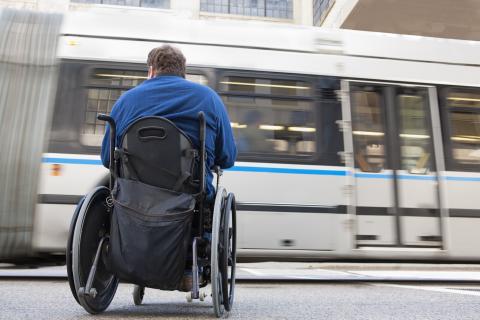
Many people take it for granted that they can move around freely and travel spontaneously by using public transport. But for people with reduced mobility, this is often not possible, due to a lack of accessibility arrangements. To discuss these matters, the European Economic and Social Committee (EESC) has held a public hearing.
The hearing Transport accessibility for persons with disabilities was held on 23 June, a few days before the deadline of 28 June by which Member States were required to enforce their own digital accessibility laws under the European Accessibility Act (EAA). The EAA aims to improve the functioning of the internal market when it comes to accessible products and services: this applies to certain elements of air, bus, rail and waterborne passenger transport services as well.
Despite some signs of progress on adapting modes of public transport to the needs of persons with disabilities (PWDs), the legislation that should enable their free and independent movement has still not been properly or uniformly implemented in all Member States.
The consequences of inaccessible public transport can have repercussions on several areas of the lives of PWDs. They can, for example, greatly undermine their opportunities to get or keep employment and to live their lives to the full as equal members of society, participants told the hearing which brought together representatives of European institutions and civil society organisations representing people with disabilities.
Dovilė Juodkaitė, member of the EESC's Permanent Group on Disability Rights, said: European Union legislation has recently made great strides to enhance respect for people with disabilities, to facilitate accessibility and to defend their right to mobility, to independent movement and to independent participation in society
.
However, much still needs to be done.
Katrin Langensiepen, MEP and member of the Disability Intergroup at the European Parliament, called for a network of strong new accessibility centres composed of experts, people with disabilities and their organisations and national stakeholders to support and advise the Member States in implementing accessibility requirements
, in order to harmonise public transport systems in the European Union by setting cross-border standards, such as technical standards.
The European disability card, which was tested in eight Member States between 2016 and 2019, was the first step towards this objective: its goal is to facilitate recognition of disability status when a person with a disability travels or moves to another Member State.
In December 2021, the European Commission proposed a revision of the 2013 regulation on the EU guidelines for the development of the trans-European transport network. Article 4 of the proposal emphasises ensuring the accessibility of public transport for people with a disability or reduced mobility. The Parliament has started to work on the proposal and the trilogue between the Commission, EP and Council will start in early 2023, according to Eddy Liegeois, Head of the Transport Networks Unit at DG MOVE.
Summing up the conclusions of the first panel, which gave the views of EU institutions, EESC member Marie Zvolská highlighted the importance of informing persons with disabilities or with reduced mobility about all of their rights. This needs to be combined with awareness-raising and the training of public transport employees.
Marie Denninghaus, Policy Coordinator at the European Disability Forum (EDF), stressed that, despite the adoption of the UN Convention on the Rights of Person with Disabilities (UNRPD) and existing European laws, EU legislation still looks like a patchwork that only partially meets the needs of people with disabilities, depending on their country of residence.
According to Ms Denninghaus, civil society organisations representing people with disabilities are not always invited to debates related to legislation on accessibility, which often results in their needs not being taken into account. However, she recognises that the EU is on the right track to settle these issues. Ms Denninghaus emphasised that all infrastructure financed by the EU should be accessible to people with disabilities
.
According to the World Health Organization (WHO), there are over one billion people with disabilities in the world. Their current global employment rate is just half that of their peers without disabilities. Transport opportunities are key to changing the narrative and improving equality by removing barriers to their participation in society.
Additionally, poor accessibility of public transport, which limits freedom of movement not only for persons with disabilities, but also for people travelling with babies or heavy luggage, is also harmful for the environment. Indeed, as a consequence of poorly accessible public transportation, many people prefer to use private cars or are left with no other alternative.
We cannot expect people with disabilities to make more sustainable choices if they have limited choices. We cannot work towards a more equal society if they are not able to participate in that society, if they do not have sufficient economic resources and sufficient support,
said Sandra Lima, Project Manager at the European Passengers' Federation (EPF).
In her concluding remarks, Ms Juodkaitė put forward the objectives which in her view should top the EU agenda when it comes to making public transport more accessible for people with disabilities: We need to stop the excessive fragmentation of legislation and of modes of transport, and we need to improve monitoring of the implementation of legislation at European and national level. Despite signs of progress, there are still many gaps in the way measures are implemented
.
Work organisation
Recommended for you
Toghadh Séamus Boland ina Uachtarán ar Choiste Eacnamaíoch agus Sóisialta na hEorpa, agus gheall sé go gcuirfear an tsochaí shibhialta i gcroílár na hEorpa
News
Toghadh Séamus Boland na hÉireann ar an 35ú Uachtarán ar Choiste Eacnamaíoch agus Sóisialta na hEorpa (CESE) le haghaidh an téarma oifige 2025-2028. Is urlabhra riamh anall é do phobail na tuaithe…
CESE, Uachtarántacht na hÉireann agus an fhís choiteann atá acu
News
I ndiaidh na díospóireachta a reáchtáladh le Comhaltaí CESE le linn sheisiún iomlánach mhí Iúil, níl aon dabht faoi ach go bhfuil clár Uachtaránacht reatha an Aontais ag freagairt go mór do na…
#YEYS2022: Ceist na bréagaisnéise pléite ag aos óg na hEorpa agus a dtuairimí ina leith curtha in iúl acu don Leas-Uachtarán Jourová
News
Chuir daltaí meánscoile ó gach cearn den Eoraip ocht gcinn de thograí nithiúla faoi bhráid Leas-Uachtarán an Choimisiúin Eorpaigh um Luachanna agus um Thrédhearcacht, Věra Jourová. Bhí páirt á…
#CivilsocietyforUkraine
News
Cáineann CESE ionradh Rialtas na Rúise ar an Úcráin, ionradh atá gan údar agus gan chúis Rún ó Choiste Eacnamaíoch agus Sóisialta na hEorpa (CESE) maidir leis an gcogadh san Úcráin agus an tionchar…
Eagrán speisialta de CESE info
News
Eagrán speisialta de CESE info atá dírithe ar an Úcráin. Is féidir scéal Tetyana Ogarkova a léamh, bean a chuala fuaim ionradh na Rúise ar dhúiseacht di an 24 Feabhra.