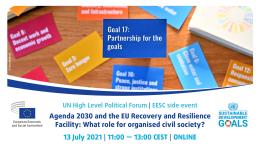
On 13 July 2021, the European Economic and Social Committee (EESC) will hold a public side-event in the context of the United Nations' High Level Political Forum on sustainable development (HLPF), an annual space to review commitment and progress made on the 2030 Agenda for Sustainable Development, which will be held from 6th to 15th July 2021 in New York.
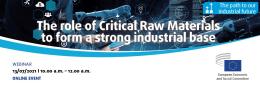
Between June 2021 and March 2022 the European Economic and Social Committee is organising a series of events on the updated new industrial strategy, announced by the European Commission on 5 May 2021. The main objective of these events is to hear the view of civil society organisations on the future of European industry. Each event will focus on a specific aspect of the strategy, from the role of critical raw materials to industry's role to achieve the Green Deal, from Europe's competitiveness on the global stage to a truly Just Transition and public & private investments.
562nd plenary session of the EESC, with the following guests: Anže Logar, Minister of Foreign Affairs of Slovenia, A post-Covid economy that works for all - Towards a well-being economy? with Tim Jackson, James Watson, Sandrine Dixson-Declève and Fabrice Murtin, and a debate on Artificial Intelligence and Machine Learning with Jayant Narayan.
This online hearing organised by the Consultative Commission on Industrial Change (CCMI) will gather views from key industry stakeholders on how the EU Recovery Plan can support Resource and Energy-Intensive Industries (REEIs) in their socially acceptable transition towards de-carbonisation and digitalisation.
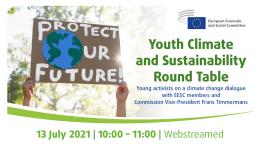
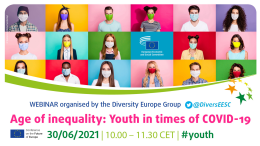
The webinar will explore two inter-related questions: How has the COVID-19 crisis affected the mental health of young people in Europe and what has been the impact on their employability? It will be an informal and fully virtual event on Microsoft Teams in English only.
The Covid-19 pandemic has resulted in major economic and social impacts across the EU, worsening the already precarious situation of marginalised communities, amongst them the Roma. The hearing aims to look at the Covid situation for the Roma community living in settlements, as well as their access to services, particularly health services. It will then discuss the measures that are needed to address the situation, with the participation of organisations from various Member States.
Strategic foresight is increasingly being embedded into EU policy making. It involves exploring different possible future scenarios and considering the opportunities and challenges connected to them, to contribute to policy action that shapes the future in a way we would like.
The conference will focus on the economic aspects of strategic foresight, and how strategic foresight influences considerations and policy making in public authorities in the EU, and how economic and social actors use foresight in their organisations.
In the framework of the elaboration of its own-initiative opinion on "Advertising for modern, responsible consumption", the EESC organized a hearing which aimed at gathering the point of view of different actors. The conclusions of the hearing will then be integrated into the opinion.