points out that there is still a long way to go to reach the final objectives of decarbonisation and transition to a more sustainable economy, objectives that were set out by the Commission in its original Green Deal formulation. Companies need much more certainty, global agreement, guidance, sophisticated accountability methods and, ultimately, support from legislators;
highlights the urgent need for public funds to be strategically allocated to goals that are jointly agreed on by European policy-makers and civil society. This initiative must be closely interlinked with the industrial strategy;
emphasises that Member States need EU-level support and civil society input to assist companies through guidance, benchmarking and shared learning capacities to adopt and carry out the structural reforms flowing from the Green Deal: bolstering employment rates, enhancing access to skills and labour, and promoting flexibility and efficiency in labour markets.
Public debate with Fabian Zuleeg, Chief Executive and Chief Economist, European Policy Centre (EPC)
Event type
Debate
Location
Online event
Belgium
Public debate on Reforms for a more resilient economy for all: the new EU legislature with Fabian Zuleeg, Chief Executive and Chief Economist, European Policy Centre (EPC)
Vedtaget on 30/04/2025 - Bureau decision date: 11/07/2024
Reference
ECO/652-EESC-2024
Rapporteur
, Luca JAHIER (Civil Society Organisations - GR III/Italy)
Plenary session number
596
-
Information Report ECO/651 and Own-initiative opinion ECO/652 are a continuation of the European Semester Group's (ESG) work to consult annually national economic and social councils, social partners and civil society organisations from EU Member States on reform and investment proposals made in the context of the European Semester and their implementation in the Member States. The Information Report aims to collect the views of social partners and civil society organisations in the Member States on the reform and investment proposals and their implementation, in particular those indicated in the 2024 Country-Specific Recommendations. The Own-initiative opinion aims to complement the Information Report and to include the EESC's policy recommendations based on the results of the stakeholder consultation. It allows the EESC to formulate general and specific considerations, and to present the associated EESC's conclusions and policy proposals.
Download — Udvalgets udtalelse: The EESC's recommendations on the reform and investment proposals formulated as part of the 2024-2025 European Semester cycle
Information Report ECO/651 and Own-initiative opinion ECO/652 are a continuation of the European Semester Group's (ESG) work to consult annually national economic and social councils, social partners and civil society organisations from EU Member States on reform and investment proposals made in the context of the European Semester and their implementation in the Member States. The Information Report aims to collect the views of social partners and civil society organisations in the Member States on the reform and investment proposals and their implementation, in particular those indicated in the 2024 Country-Specific Recommendations. The Own-initiative opinion aims to complement the Information Report and to include the EESC's policy recommendations based on the results of the stakeholder consultation. It allows the EESC to formulate general and specific considerations, and to present the associated EESC's conclusions and policy proposals.
Download — Information report: The point of view of organised civil society in the EU Member States on national reform and investment proposals and their implementation (2024-2025 European Semester cycle)
This document summarises the Employers’ Group view on the social dimension of the EU for the next political cycle and its reflections after the La Hulpe Declaration.
EESC with this Resolution, calls on the Member States of the European Union and its leaders, the European institutions and the EU citizens, to safeguard and protect the economic, social and territorial cohesion of the EU according to Article 174 of the TFEU.
The fundamental principle of cohesion policy, according to which ‘no one should be left behind’, remains sound and valid. Civil society partners are ready to continue working towards it by means of a solid EU investment policy.
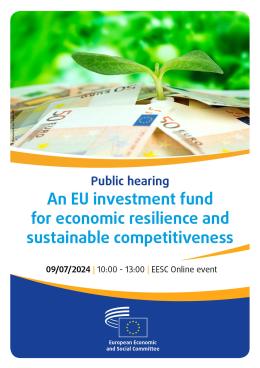
The Section for Economic and Monetary Union and Economic and Social Cohesion (ECO) of the European Economic and Social Committee (EESC) is working on an own-initiative opinion on 'An EU investment fund for economic resilience and sustainable competitiveness' with the aim to develop a common narrative on the financing needs for the green transition and sketch out central elements of an EU investments fund that could allow EU Member States to more effectively address the financial needs of the Green Deal.
In the context of the work on this opinion, the ECO section decided to organise a public hearing bringing together experts from organised civil society and decision-makers. The aim of the public hearing is two-fold: on the one hand, to discuss the draft EESC opinion, and on the other hand, to collect further views and ideas to expand and refine the EESC's draft recommendations.
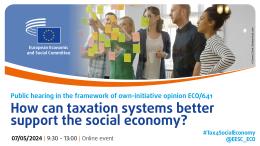
Public hearing in the framework of own-initiative opinion ECO/641 - Taxation Framework for Social Economy Entities
Event type
Public hearing
Location
Online event
Brussels
Belgium
The social economy is a vital part of the European social and economic system. It generates and maintains high-quality jobs, fosters the inclusion of marginalised groups into the labour market, promotes sustainable business practices, and provides employment for millions of people. In this way, it makes the single market more inclusive, our societies more cohesive and fosters employment models that are tailored to local and communal needs.