European Economic
and Social Committee
European Economic
and Social Committee
The European Economic and Social Committee (EESC) is the voice of organised civil society in Europe.
Find out more about its role and structure at http://www.eesc.europa.eu/en/about
The EESC issues between 160 and 190 opinions, evaluation and information reports a year.
It also organises several annual initiatives and events with a focus on civil society and citizens’ participation such as the Civil Society Prize, the Civil Society Days, the Your Europe, Your Say youth plenary and the ECI Day.
Find the latest EESC opinions and publications at http://www.eesc.europa.eu/en/our-work/opinions-information-reports/opinions and http://www.eesc.europa.eu/en/our-work/publications-other-work/publications respectively.
The EESC is active in a wide range of areas, from social affairs to economy, energy and sustainability.
Learn more about our policy areas and policy highlights at http://www.eesc.europa.eu/en/policies
The EESC holds nine plenary sessions per year. It also organises many conferences, public hearings and high-level debates related to its work.
Find out more about our upcoming events at http://www.eesc.europa.eu/en/agenda/our-events/upcoming-events
Here you can find news and information about the EESC'swork, including its social media accounts, the EESC Info newsletter, photo galleries and videos.
Read the latest EESC news http://www.eesc.europa.eu/en/news-media/news and press releases http://www.eesc.europa.eu/en/news-media/press-releases
The EESC brings together representatives from all areas of organised civil society, who give their independent advice on EU policies and legislation. The EESC's326 Members are organised into three groups: Employers, Workers and Various Interests.
Find out more about our Members and groups at http://www.eesc.europa.eu/en/members-groups
The EESC has six sections, specialising in concrete topics of relevance to the citizens of the European Union, ranging from social to economic affairs, energy, environment, external relations or the internal market.
Find out more at http://www.eesc.europa.eu/en/sections-other-bodies
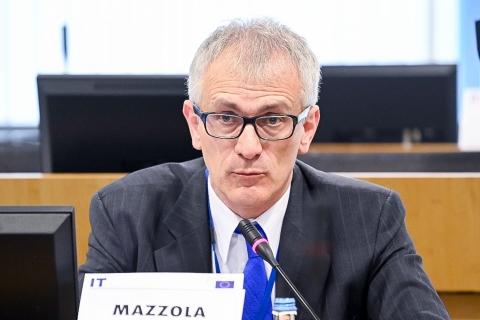
Konstante ændringer i EU-medlemsstaternes interne politiske prioriteter er en væsentlig hindring for at opnå en rettidig gennemførelse af projekterne som led i de transeuropæiske transportnet (TEN-T), og dette skaber tvivl om, hvorvidt det vil kunne lade sig gøre at fuldføre hovednettet inden 2030. Advarslen kommer fra Alberto Mazzola i informationsrapporten "Evaluering af retningslinjerne for det transeuropæiske transportnet (TEN-T) 2013-2020", der blev vedtaget på EØSU's plenarforsamling i juli.
De centrale forhindringer for fuldførelsen af TEN-T-projekterne omfatter ikke alene ændringer i de nationale politiske prioriteter, som navnlig berører grænseoverskridende projekter, men også modstand fra borgere og andre aktører. Dette viser, at TEN-T-politikken er forbundet med betydelige sociale og økonomiske problemstillinger, hvor civilsamfundets behov skal tages i betragtning. Det er kun, hvis civilsamfundsorganisationerne inddrages og høres på et tidligt stadium, at man kan foretage en behørig opfølgning og fjerne hindringerne for projektets gennemførelse.
Under plenardebatten sagde Alberto Mazzola: "Vi er ligesom interessenterne i tvivl om, hvorvidt hovednettet kan færdiggøres inden 2030, men vi mener, at dette mål er vigtigt for at presse medlemsstaterne til at arbejde hårdere, og vi tror, at flere større grænseoverskridende projekter kan være afsluttet inden da. Civilsamfundets deltagelse i og overvågning af korridorernes og projekternes udvikling er afgørende for at gennemføre dem på den mest hensigtsmæssige måde. Hvor dette er sket på et tidligt tidspunkt gennem omfattende oplysningskampagner, skrider projekterne fornuftigt frem, mens de møder stor modstand fra dele af befolkningen, når dette ikke har været tilfældet." (mp)