
European Economic
and Social Committee
European Economic
and Social Committee
The European Economic and Social Committee (EESC) is the voice of organised civil society in Europe.
Find out more about its role and structure at http://www.eesc.europa.eu/en/about
The EESC issues between 160 and 190 opinions, evaluation and information reports a year.
It also organises several annual initiatives and events with a focus on civil society and citizens’ participation such as the Civil Society Prize, the Civil Society Days, the Your Europe, Your Say youth plenary and the ECI Day.
Find the latest EESC opinions and publications at http://www.eesc.europa.eu/en/our-work/opinions-information-reports/opinions and http://www.eesc.europa.eu/en/our-work/publications-other-work/publications respectively.
The EESC is active in a wide range of areas, from social affairs to economy, energy and sustainability.
Learn more about our policy areas and policy highlights at http://www.eesc.europa.eu/en/policies
The EESC holds nine plenary sessions per year. It also organises many conferences, public hearings and high-level debates related to its work.
Find out more about our upcoming events at http://www.eesc.europa.eu/en/agenda/our-events/upcoming-events
Here you can find news and information about the EESC'swork, including its social media accounts, the EESC Info newsletter, photo galleries and videos.
Read the latest EESC news http://www.eesc.europa.eu/en/news-media/news and press releases http://www.eesc.europa.eu/en/news-media/press-releases
The EESC brings together representatives from all areas of organised civil society, who give their independent advice on EU policies and legislation. The EESC's326 Members are organised into three groups: Employers, Workers and Various Interests.
Find out more about our Members and groups at http://www.eesc.europa.eu/en/members-groups
The EESC has six sections, specialising in concrete topics of relevance to the citizens of the European Union, ranging from social to economic affairs, energy, environment, external relations or the internal market.
Find out more at http://www.eesc.europa.eu/en/sections-other-bodies
Opnåelse af klimaneutralitet vil i høj grad afhænge af EU's evne til at gå i dialog med borgerne. Håndtering af klima- og miljøudfordringer er blevet en topprioritet for EU. I lyset af både klimaændringer og klimakrise er EU nødt til at foretage betydelige ændringer for at fremme en velfærdsøkonomi.
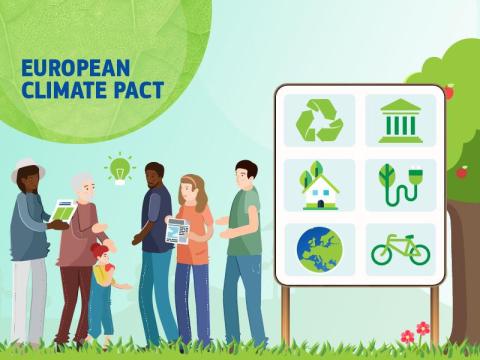
Med henblik på at imødegå disse udfordringer og realisere disse ændringer vedtog Kommissionen den europæiske grønne pagt og indledte en høring med det formål at indsamle synspunkter om, hvordan man kan inddrage offentligheden i den europæiske klimapagt.
EØSU blev derfor opfordret til at vejlede om, hvordan man kan bygge videre på eksisterende strukturer som f.eks. borgerdialoger og borgerforsamlinger og på den måde opnå det ønskede samfundsengagement i verdensmålene for bæredygtig udvikling, idet resultaterne af samtlige tiltag på klimaområdet vil afhænge heraf.
"I forbindelse med gennemførelsen af klimapagten har Kommissionen en stor mulighed for og forpligtelse til at udvikle en nyskabende tilgang, der afspejler, støtter og inspirerer den indsats, der allerede sker i civilsamfundet, i lokalsamfund og i byer og regioner", fremhævede Dimitris Dimitriadis, ordfører for udtalelsen om den europæiske klimapagt.
Kommissionen foreslår derudover at indarbejde et nyt mål for 2030 i EU's lovgivning ved hjælp af det nye forslag til en europæisk klimalov, som fastsætter et juridisk bindende mål om drivhusgasneutralitet inden 2050.
"Nu hvor vi skal i gang med genopretningen efter covid-19-krisen, er tiden kommet til, at civilsamfundet og myndighederne går sammen om at gennemføre klimaloven. Pandemien har fået os til at indse, at vi virkelig kan gøre tingene meget anderledes, hvis vi anstrenger os", understregede Jan Dirx, ordfører for udtalelsen om klimaloven. (mr)