European Economic
and Social Committee
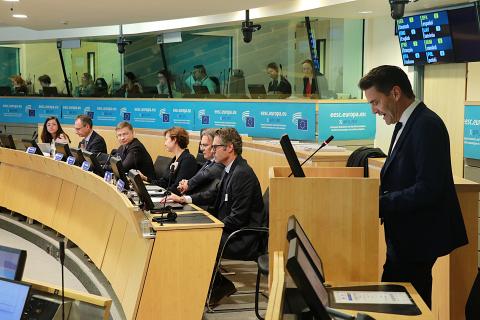
Opening speech by EESC Employers Group's President Stefano Mallia at the launch event of the new study "A Business-Centric Approach to Cutting Red Tape"
Commissioner Dombrovskis,
Distinguished guests, colleagues, and friends,
It is my pleasure to welcome you all to this event during which we are launching our study which deals with the use of AI and better policy making.
It's a particular honour to welcome you back, Commissioner Valdis Dombrovskis.
Before we go any further, I want to express our sincere thanks to our Latvian members, Mr. Gavrilovs and Ms. Zarina—who unfortunately is not with us today. You have been instrumental in facilitating today’s exchange and helping bring this discussion to life.
It is also a pleasure to welcome our external guests joining us both in-person and online from various services of the European Commission, the European Parliament, Permanent Representations, and several business stakeholders.
Dear Commissioner,
When you joined us back in September 2023, the conversation on competitiveness was just beginning to break through. The Commission had published its Long-Term Strategy, and the seeds of change were there—but the ground was still hard. In many corners of Brussels, competitiveness was still treated as a secondary issue.
Today, that’s no longer the case. The shift is real. The tone has changed. The urgency is understood. And for the first time in years, competitiveness has moved from the margins to the mainstream.
No longer just on the radar—it is now the compass guiding the EU’s economic direction, marked by the adoption of the Competitiveness Compass and concrete initiatives such as the Omnibus Simplification Packages.
Yet the benefits for businesses on the ground are still pending the full implementation of these initiatives.
According to Eurostat, the EU’s recurring administrative costs amounted to approximately euro 150 billion in 2022. An astounding figure by any measure.
This is the context in which we launch our initiative today. Today we bring forward a tool. A method, and a mindset.
Our AI-powered Regulatory Burden Index is designed to complement—and reinforce—the Commission’s goals, as outlined in the 'Simpler and Faster Europe' Communication. We share the same priorities: reducing reporting obligations, enhancing legal clarity, and ensuring more coherent implementation across Member States.
However, while the Commission rightly targets administrative simplification and better cooperation, our approach calls for a deeper structural shift.
Simplification must be systemic, measurable, and enforceable—at all levels of governance.
Our AI Regulatory Burden Index introduces a structural, entrepreneur-centred approach. It captures not only the direct regulatory load from EU-level legislation, but also very importantly the cumulative burden stemming from national implementation, gold-plating, administrative duplication, and enforcement disparities.
It shifts the focus from abstract targets to concrete impact—measured from the perspective of those who navigate these rules daily.
Simplification must not stop at the regulation. It must extend to how laws are interpreted, transposed, and enforced across Member States.
We believe the tool we are proposing should be scaled up and embedded in the EU’s policymaking process. It should not be a post-legislative assessment instrument, but a core component of better regulation—shaping proposals from the outset, strengthening impact assessments, and enabling continuous reality checks.
Simplification should not be a last-minute edit. It must be the mindset we begin with.
Commissioner this also brings me to another point where we have serious concerns – and this is the institutional set up at the moment where at least to us it seems that responsibilities are fragmented.
We have:
- Regulatory oversight which lies with the Secretariat General
- Simplification which lies with you Commissioner
- Digital sovereignty which lies with executive VP Virkkunen, and
- Business engagement which lies with Executive VP Séjourné.
Our hope is that the simplification effort, including the adoption of digital tools, will be consolidated under your leadership so that in this way we will have a focal point and can register rapid progress.
Dear Commissioner,
As the Employers’ Group we are working to provide you with a concrete and practical solution. We of course would like to take this further and operationalise this approach.
In the recent past, we contributed concretely by putting forward the Competitiveness Check and now we want to contribute again by proposing this digital tool.
As the EESC we are also currently preparing an opinion exactly on the topic of using digital tools in better law making. It will be ready in July.
I will conclude by saying that the EU has the ambition to lead in global competitiveness. That leadership must now be matched with tools, structures, and commitments that deliver measurable impacts
Thank you—and I look forward to a forward-thinking and action-oriented discussion today.
More information