The Spanish Presidency of the Council of the EU: Opportunities and Challenges
In this issue:
Our members write about their expectations and proposals for the Spanish Presidency
Guest articles by Lourdes Márquez de la Calleja (Director of Alliances and International Relations at Fundación ONCE) and Victoria Ortega (President of Unión
Profesional and First Vice-President of CEPLIS)
Comment on the proposed reform of the European electricity market by rapporteur Jan Dirx
Interview on measures to fight stigma against HIV with rapporteur Pietro Vittorio Barbieri
In the coming months, the Spanish Presidency will have a crucial role to play at Europe’s helm. The European Economic and Social Committee will work closely with the Presidency in building a more resilient, inclusive and safer Europe, one that delivers for its citizens and effectively tackles the challenges ahead.
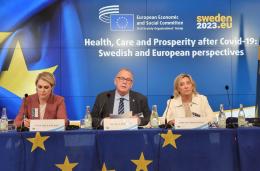
Healthcare must be people-centred and valued as a social investment, not a 'cost', concluded a conference organised by the Civil Society Organisations' Group of the EESC at the House of Europe in Stockholm on 25 May 2023. For this to happen it is necessary to change mindsets socially, economically and politically. Building on cooperation during the COVID-19 pandemic, EU Member States need to join forces to build resilient and sustainable health and care systems that leave no one behind and value the work of care workers, civil society organisations and volunteers.
The ECO Section organizes this public hearing to discuss on the current framework on resolution and insolvency, supervision, and bank deposit insurance scheme, and its reform. This event will bring institutional actors and civil society. Its conclusions will feed the work on the EESC opinion on the reform of the bank crisis management and deposit insurance framework.
As Sweden takes over the Presidency of the Council of the European Union, the ongoing crises of the war in Europe, the accelerating energy crisis and economic stagnation continue to be among the main political focus points. Our shared aims are to safeguard sustainable growth and competitiveness, while executing the green and digital transition and define our standing in the world and the well-being of our citizens.
The EESC is committed to contributing to the Swedish presidency and to working together to restore much needed balance and stability in Europe.
The EESC opinion, that covers the Commission proposal and the request from the Spanish Presidency of the Council, endorses the reform. However, it notes the need to strike a balance between flexibility and predictability in its implementation, as well as a balanced and proportional public interest assessment to avoid damaging the interest of smaller and local entities.
Download format:
Download — Становище на ЕИСК: Review of the Bank crisis management and deposit insurance framework