
European Economic
and Social Committee
WATER POVERTY: SAVING WATER AT ALL COSTS
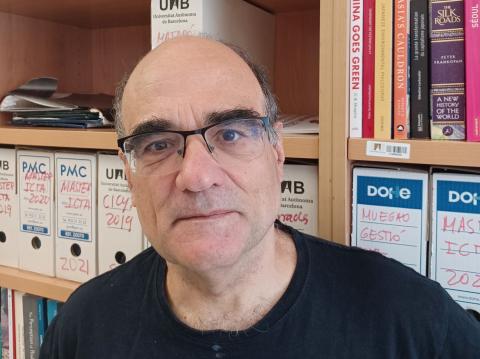
Access to clean water is often taken for granted in Europe. Yet many households struggle to pay their water bills, quietly cutting back on showers, laundry and other basic needs. Drawing on research in the Barcelona area, geographer David Saurí tells EESC Info how water poverty affects health, dignity and daily life – and why saving water alone cannot solve the problem.
Your research with households in the Barcelona province looks at how people experience water poverty in their everyday lives. What did you learn from their experiences, and what do these accounts reveal about the reality of water poverty?
In our study, water poverty was not expressed as a lack of physical access to clean water but as difficulty affording it. Hence, water poverty was treated mostly in terms of affordability and experienced through the stress and anxiety of not being able to pay the water bill and thus incurring debt or, worse, being disconnected from the service. Households made strenuous efforts to save as much water as possible and to obtain financial assistance from family, friends or institutions to ease the costs. However, our interviews also highlighted the fact that a daily shower in summer, using the washing machine and flushing the toilet were seen as essential uses that could not and should not be questioned. In this context, water poverty, defined as the inability to pay for sufficient and safe water, exposes households to the risks of marginalisation and exclusion characteristic of poverty in general.
People facing water poverty may respond by taking shorter showers, using washing machines less often or limiting other everyday water use. What are the consequences of these coping strategies for people's health, dignity and quality of life?
In our case study, coping strategies, mostly organised and carried out by women, aimed to reduce consumption as much as possible, even at the risk of jeopardising the health and well-being of household members. One consequence of saving water at all costs was tension within households, especially between adults and children and teenagers over issues such as the time spent showering. Adults often complained that their sons, and especially their daughters, spent too much time showering. However, longer showers may not always be due to grooming, but also to specific hygiene needs, as in the case of women. Among teenagers, strong peer-group influence also seems to be an important reason for spending more time on grooming, including showering. For certain household members, water may play a significant role in daily life because of a combination of cultural and health factors. Limiting water use to a three-minute shower may undermine this and cause stress and anxiety among children and teenagers.
When households are already making considerable efforts to reduce their water consumption, but see little difference in their bills, what does this tell us about the limits of asking individuals to solve water affordability through behavioural change?
The responses to our survey showed that pursuing water savings to the extreme could be stressful, especially when, according to some respondents, water-saving behaviours did not lead to noticeable reductions in water bills. The study also showed that domestic water-saving technologies remain beyond the reach of poorer households, which can only rely on behavioural change to curb water consumption. In our study, almost half of the households interviewed did not have dual-flush toilets, fewer had water-saving mechanisms installed in taps or shower heads, and even fewer could afford an efficient washing machine. In the case of domestic water use, old and inefficient fixtures, such as toilets, showers and taps, may result in higher consumption and therefore higher water bills. Richer households, on the other hand, had efficient water fixtures and appliances and may therefore have less need to save water by changing their behaviour. Still, according to our interviews, there were some red lines regarding water use that could not be crossed. Respondents felt entitled to shower at least once a day in summer, believed that toilets needed to be flushed and considered washing machines essential to a healthy and dignified life.
Water poverty is not always visible, particularly when households remain connected to the water supply. How can policy-makers and public authorities identify people who are struggling to afford enough water, and understand the extent of the problem?
The invisibility of water poverty is a real concern, and the number of water-poor people in developed countries may be higher than some estimates indicate. In the Metropolitan Area of Barcelona, around 125 000 households (roughly 10% of the total) were classified as water poor in 2019. In this case, the metric used was spending 3% or more of household income on water. In England, this figure may be as high as 20%. Meanwhile, some 56 000 households in the Barcelona Metropolitan Area received subsidies to help with water payments, and 76 000 did not have to pay the Catalan water tax. That said, the number of water-poor individuals and families may be significantly higher than these figures suggest. Feelings of guilt and shame about being unable to pay and thus incurring debt or being disconnected from the service, may force water-poor people to rely quietly on family and friends for help or to make extreme water savings. Policy-makers and public authorities can access data from water companies, NGOs working on poverty or local social services to identify people experiencing water poverty, but the full extent of the problem is likely to remain unknown.
What factors make households particularly vulnerable to water poverty, and how does it intersect with other forms of deprivation, such as energy poverty or housing insecurity?
The factors that create vulnerability to water poverty are substantially no different from those that create vulnerability to poverty in general. In our study, a significant number of households experiencing difficulties with their water bills were tenant-headed households or households headed by single women of non-Spanish origin with children, which had been identified as vulnerable by NGOs or local social services. Most households experiencing water poverty were also experiencing energy poverty. Comparisons between water and energy management at household level yielded interesting results regarding which resource was more difficult to save. However, the evidence was inconclusive, as neither clearly stood out. While energy was usually more expensive and difficult to control, water was considered more essential, to the point that most respondents said they could manage to some extent without electricity, but not without water.
What measures can help ensure that everyone can afford the water they need for a decent standard of living? What role should public authorities, water providers and civil society organisations play?
We have identified two basic approaches to ensuring that everyone can afford the water they need for a decent standard of living. The first is what we might call conventional poverty alleviation. Under this approach, subsidies, direct payments and other financial arrangements are made available to vulnerable households so that they can fulfil their contractual obligations and pay for water services. Issues such as the fairness of water prices or the governance of domestic water services are not questioned. The second approach also mobilises poverty assistance mechanisms but takes a different view of more structural issues, such as pricing and governance. The price of domestic water in Barcelona is the second highest among Spanish cities, while the service provider is a public-private company in which the private partner holds most of the shares. Some organisations propose lowering the price of water or, at least, providing part of the water used by the more vulnerable households - say, the first 50 litres per person per day - free of charge. These organisations also argue that water prices, and therefore water poverty, would be lower under public management. However, evidence supporting this claim remains elusive.
David Saurí is a professor in the Department of Geography at the Universitat Autònoma de Barcelona (UAB), where he has taught since 1988, and holds a PhD in geography from Clark University in the United States. His research focuses on water, natural hazards and the impacts of climate change on cities, highlighting the contribution of geography and the social sciences. His recent work includes two 2026 studies on 'Lived experiences of water poverty in Barcelona' and on the links between 'Water poverty, sociomaterial conditions and climate change […] in the Global North'. In 2003 he was commissioned to establish UAB’s Institute of Environmental Science and Technology.