European Economic
and Social Committee
European Economic
and Social Committee
The European Economic and Social Committee (EESC) is the voice of organised civil society in Europe.
Find out more about its role and structure at http://www.eesc.europa.eu/en/about
The EESC issues between 160 and 190 opinions, evaluation and information reports a year.
It also organises several annual initiatives and events with a focus on civil society and citizens’ participation such as the Civil Society Prize, the Civil Society Days, the Your Europe, Your Say youth plenary and the ECI Day.
Find the latest EESC opinions and publications at http://www.eesc.europa.eu/en/our-work/opinions-information-reports/opinions and http://www.eesc.europa.eu/en/our-work/publications-other-work/publications respectively.
The EESC is active in a wide range of areas, from social affairs to economy, energy and sustainability.
Learn more about our policy areas and policy highlights at http://www.eesc.europa.eu/en/policies
The EESC holds nine plenary sessions per year. It also organises many conferences, public hearings and high-level debates related to its work.
Find out more about our upcoming events at http://www.eesc.europa.eu/en/agenda/our-events/upcoming-events
Here you can find news and information about the EESC'swork, including its social media accounts, the EESC Info newsletter, photo galleries and videos.
Read the latest EESC news http://www.eesc.europa.eu/en/news-media/news and press releases http://www.eesc.europa.eu/en/news-media/press-releases
The EESC brings together representatives from all areas of organised civil society, who give their independent advice on EU policies and legislation. The EESC's326 Members are organised into three groups: Employers, Workers and Various Interests.
Find out more about our Members and groups at http://www.eesc.europa.eu/en/members-groups
The EESC has six sections, specialising in concrete topics of relevance to the citizens of the European Union, ranging from social to economic affairs, energy, environment, external relations or the internal market.
Find out more at http://www.eesc.europa.eu/en/sections-other-bodies
The EU must shift from reactive ‘firefighting’ to long-term disaster foresight if it wants to protect its citizens effectively, the European Economic and Social Committee (EESC) warned in a new opinion adopted in December. The call comes as Europe faces more frequent climate extremes, growing cyber-physical risks and geopolitical instability.
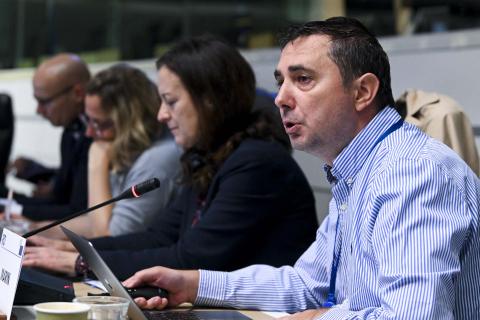
According to rapporteur Florian Marin, the EU still treats disasters as isolated shocks rather than predictable, interconnected threats. ‘Prevention is no longer optional’, he said, arguing it is Europe’s most cost-effective and humane form of defence.
While the Union Civil Protection Mechanism (UCPM) has been strengthened in recent years, most notably with the rescEU reserve after devastating wildfires, the EESC says the system remains overly focused on emergency response rather than risk reduction. Fragmentation between civil protection, climate adaptation and security policies continues to limit coordination.
The Committee calls for less red tape, modernised data and early-warning systems, more trained staff, streamlined procurement and stable funding for professionals and volunteers. Disaster-risk reduction should also become a core pillar of the EU’s 2028-2034 regional planning.
Recent cross-border flood responses show what is possible. ‘A prepared Union is a stronger Union’, Mr Marin concluded. Europe cannot afford to wait for the next crisis. (ks)