Fundamental Rights and the Rule of Law

This page is also available in:

The EU is not only a common market; it is a union of common values that shape the European identity. These values are set out in the Treaty on the European Union and also include the rights, freedoms and principles laid out in the Charter of Fundamental Rights: the "indivisible, universal values of human dignity, freedom, equality and solidarity; [the Union] is based on the principles of democracy and the rule of law. It places the individual at the heart of its activities, by establishing the citizenship of the Union and by creating an area of freedom, security and justice."

The Charter brings together into a single text all the personal, civic, political, economic and social rights enjoyed by people within the EU and apply to the EU institutions and Member States when they implement EU law.

The EESC is very active in the promotion of fundamental rights, the rule of law and democracy, and especially in the fight against discrimination based on race, ethnic origin, disability or gender. In 2018, it established the Group on Fundamental Rights and the Rule of Law to further expand analysis of the situation across Europe and promote a constructive dialogue amongst all stakeholders.
  • Reference number
    34/2024

    With hate speech and hate crime rising at a frightening rate, Europeans are joining forces and stepping up action against all forms of hatred to send the message that there is no place for hate in the EU

  • Addressing immediate and long-term challenges, properly implementing existing EU policies and strengthening EU values are some of the priorities proposed by civil society organisations for the new mandate, along with structured civil dialogue and a strong social agenda.

  • A properly structured civil dialogue can be a means of making European democracies more resilient to current societal challenges. Civil society organisations (CSOs) trust in the European Parliament to be the driving force when it comes to an agreement on structured civil dialogue between the Council of the European Union, the European Commission and the European Parliament, as a Parliament resolution proposed such an agreement in 2022. CSOs consider such an inter-institutional agreement a basis for developing more inclusive and qualitative policy-making.

  • Reference number
    43/2023

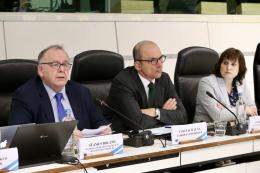
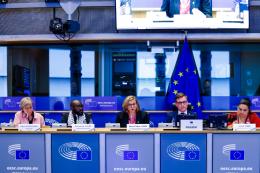
    A new report from the Fundamental Rights and Rule of Law (FRRL) Group of the European Economic and Social Committee (EESC) highlights the growing challenges civil society organisations face in Europe. The report was unveiled on 7 November during the FRRL Group's conference on the current state of the rule of law and its impact on civic space.

  • In an opinion adopted at its September plenary session, the European Economic and Social Committee (EESC) took a closer look at the European Integrated Border Management Strategy (EIBM), emphasising the need for a shared strategy, improved coordination, and fundamental rights protection in European border management.

  • The European Economic and Social Committee (EESC) has slammed the EU for its inadequate support and insufficient funding for civil society organisations working in the area of fundamental rights, the rule of law and democracy. With civil society encountering ever more difficulties, the EESC announced that it would monitor the situation of democracy and human rights defenders more closely, both in the EU and in enlargement countries

  • Despite being recognised as a constitutional principle of the EU, participatory democracy in Europe is still largely unstructured, with no formal institutional agreements that would allow citizens and civil society organisations to directly contribute to the development of EU policies


  • With populism and authoritarianism on the rise across Europe, civil society organisations face growing hostility. Battling with financial constraints, smear campaigns, political attacks and legal and administrative obstacles, they urgently need reinforced support on all fronts to be able to play their key role of making our societies more open, more accountable and just.

  • Civil society organisations (CSOs) must be recognised, involved and supported as partners that defend and strengthen European democracy and contribute to a functioning rule of law culture.

  • In its March plenary, the European Economic and Social Committee (EESC) adopted an opinion urging the European Institutions to address the fragmented implementation of foreign policy sanctions across Member States. The EESC is concerned about the inconsistency in standards and in the application of sanctions in national legislation, and is calling for immediate action to protect humanitarian aid and journalists in sanctioned regimes.