
European Economic
and Social Committee
EESC and EP presidents: the EU's competitiveness is becoming more important than even before
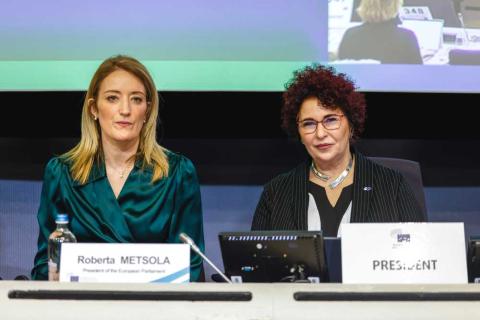
At the European Economic and Social Committee plenary session on Wednesday, EESC members discussed the EU's response to geopolitical challenges with Roberta Metsola, President of the European Parliament. The presidents of both institutions agreed that competitiveness, together with more strategic autonomy, is crucial in the current challenging times.
President Metsola put emphasis on the single market and the opportunities it offers: We must return to growth and lower our dependencies, while doubling-down on the green and digital transitions. Europe should play on its strengths wisely and make sure our active trade policy brings benefits to Europeans every day
.
For EESC President Christa Schweng, these aspects are essential for the prosperity of people and businesses in the EU: It is a make-or-break moment, and only through coordinated efforts can we successfully build a more resilient, fair and sustainable future in which nobody is left behind.
The discussion also touched on the EU's response to external economic factors such as the American Inflation Reduction Act, Russia's war of aggression against Ukraine, and the volatility of fossil fuel prices, and internal challenges such as the lack of a skilled workforce that Europe is currently experiencing.
A well-functioning democracy is essential for European society to be able to successfully face current challenges. That is why the EESC and the European Parliament are looking to further strengthen their cooperation, and actively work on ensuring the highest possible turnout in the upcoming European elections in 2024.
The debate demonstrated that civil society has a critical role to play in improving EU policies and the way they are implemented. Citizens want a bigger say in the EU, a point proven during the Conference on the Future of Europe. The EESC will continue its efforts to link EU policy-makers with representatives of organised civil society, to make use of their expertise and hands-on experience.
Work organisation
Downloads
-
PR EESC and EP presidents: the EU's competitiveness is becoming more important than even before
Recommended for you
Il-KESE jappella għal regolamentazzjoni b’saħħitha u ssemplifikata tal-kriptoassi
News
Il-Kumitat Ekonomiku u Soċjali Ewropew jappoġġja żieda fir-regolamentazzjoni tal-kriptoassi, b’regoli robusti u koerenti biex l-investituri fl-UE jiġu protetti aħjar, f’konformità mal-miżuri attwali…
L-istrumentalizzazzjoni tal-migranti u l-kriżi tar-refuġjati tal-Ukrajna jappellaw għal bidu ġdid għall-politika dwar il-migrazzjoni
News
L-istrumentalizzazzjoni tal-migranti sostnuta mill-Istat, li għandha l-għan li tiddestabbilizza lill-UE, u l-gwerra attwali fl-Ukrajna, li wasslet għal influss bla preċedent ta’ refuġjati, jagħmluha…
“L-Ewropa Tiegħek, Leħnek” 2023: Iż-żgħażagħ jitolbu UE aktar trasparenti, diġitali u semplifikata
News
Fit-23 u l-24 ta’ Marzu, il-Kumitat Ekonomiku u Soċjali Ewropew (KESE) ospita l-14-il avveniment L-Ewropa Tiegħek, Leħnek!, li laqqa’ fi Brussell 105 studenti minn 35 skola mis-27 Stat Membru tal-UE…
Euro-Med – L-organizzazzjonijiet tas-soċjetà ċivili huma essenzjali biex l-ekonomija u s-soċjetà jaħdmu tajjeb
News
Matul is-sessjoni plenarja ta’ Diċembru tal-Kumitat Ekonomiku u Soċjali Ewropew (KESE) sar dibattitu dwar ir-rikostruzzjoni u r-reżiljenza tar-reġjun Ewro‑Mediterranju wara l-pandemija tal-COVID-19.…
Il-KESE jiftaħ l-applikazzjonijiet għall-Premju tiegħu għas-Soċjetà Ċivili li se jkun qed jindirizza s-saħħa mentali
News
L-organizzazzjonijiet tas-soċjetà ċivili, l-individwi u l-kumpaniji privati issa jistgħu jdaħħlu l-proġetti tagħhom mingħajr skop ta’ qligħ għall-premju tal-KESE ddedikat għall-appoġġ tal-benesseri…