
European Economic
and Social Committee
EESC and EP presidents: the EU's competitiveness is becoming more important than even before
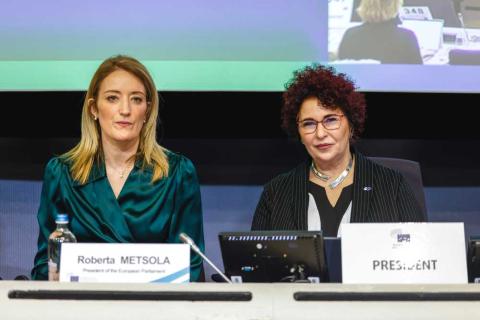
At the European Economic and Social Committee plenary session on Wednesday, EESC members discussed the EU's response to geopolitical challenges with Roberta Metsola, President of the European Parliament. The presidents of both institutions agreed that competitiveness, together with more strategic autonomy, is crucial in the current challenging times.
President Metsola put emphasis on the single market and the opportunities it offers: We must return to growth and lower our dependencies, while doubling-down on the green and digital transitions. Europe should play on its strengths wisely and make sure our active trade policy brings benefits to Europeans every day
.
For EESC President Christa Schweng, these aspects are essential for the prosperity of people and businesses in the EU: It is a make-or-break moment, and only through coordinated efforts can we successfully build a more resilient, fair and sustainable future in which nobody is left behind.
The discussion also touched on the EU's response to external economic factors such as the American Inflation Reduction Act, Russia's war of aggression against Ukraine, and the volatility of fossil fuel prices, and internal challenges such as the lack of a skilled workforce that Europe is currently experiencing.
A well-functioning democracy is essential for European society to be able to successfully face current challenges. That is why the EESC and the European Parliament are looking to further strengthen their cooperation, and actively work on ensuring the highest possible turnout in the upcoming European elections in 2024.
The debate demonstrated that civil society has a critical role to play in improving EU policies and the way they are implemented. Citizens want a bigger say in the EU, a point proven during the Conference on the Future of Europe. The EESC will continue its efforts to link EU policy-makers with representatives of organised civil society, to make use of their expertise and hands-on experience.
Work organisation
Downloads
-
PR EESC and EP presidents: the EU's competitiveness is becoming more important than even before
Recommended for you
Presidentes do CESE e do CR debatem desafios comuns para o futuro da Europa
News
Na reunião plenária de julho do Comité Económico e Social Europeu (CESE), a sua presidente, Christa Schweng, e o presidente recentemente eleito do Comité das Regiões Europeu (CR), Vasco Alves…
Movimento Transformers entre os finalistas do Prémio CESE para a Sociedade Civil dedicado à juventude
News
A associação sem fins lucrativos portuguesa Movimento Transformers figura na lista de finalistas do Prémio CESE para a Sociedade Civil de 2022 que, este ano, é atribuído a duas categorias, a saber,…
Associação portuguesa Movimento Transformers recebe Prémio CESE para a Sociedade Civil 2022 pelo apoio a jovens desfavorecidos
News
O Movimento Transformers é uma das organizações sem fins lucrativos que o Comité Económico e Social Europeu (CESE) distinguiu pelos seus projetos em prol da juventude. O Movimento Transformers…
«A tua Europa, a tua voz!» de 2023: jovens reclamam uma UE mais transparente, digital e simplificada
News
Em 23 e 24 de março, o Comité Económico e Social Europeu (CESE) acolheu a 14.ª edição do evento «A tua Europa, a tua voz!», que reuniu em Bruxelas 105 alunos de 35 escolas dos 27 Estados‑Membros da…
#RareDiseases – UE precisa de estratégia para ajudar 36 milhões de pessoas com doenças raras na Europa
News
Na conferência que organizou em Bilbau, o Comité Económico e Social Europeu (CESE) instou a União Europeia a lançar um plano de ação europeu para reforçar a cooperação entre os sistemas nacionais de…