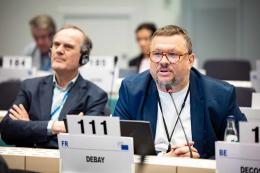
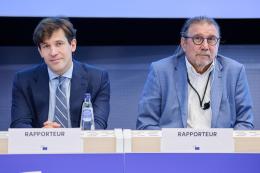
Europe's migration policy must be built on rights, integration and legal pathways, not just border controls and returns, the European Economic and Social Committee (EESC) says in its opinion on the European Migration and Asylum Strategy, adopted during its July plenary session.
Civil society organisations, individuals and private companies can now enter their non-profit projects for the EESC’s prize dedicated to combating poverty in the EU.
The fight against racism in Europe must move beyond good intentions and become a genuine political priority, the European Economic and Social Committee says in its recently adopted opinion on the EU Anti-Racism Strategy 2026-2030.
The European Economic and Social Committee (EESC) held a plenary debate with European Commission Executive Vice-President, Roxana Mînzatu, on how better protection for workers can strengthen Europe’s competitiveness. The debate focused on quality jobs and fair labour mobility, and was followed by the adoption of two related EESC opinions.
As the world celebrates the International Volunteer Year 2026 (IVY 2026), experts from across Europe gathered at an EESC hearing to underline the vital contribution that volunteers make to building resilient, prepared and cohesive societies. The hearing, organised as part of the EESC's work on the forthcoming opinion on the role of volunteering for European preparedness, explored how volunteering strengthens communities before, during and after crises.
This study analyses European Union (EU) policy through the lens of intergenerational poverty (IGP), shifting attention from poverty as a static condition to the long-term persistence and transmission of disadvantage across generations.
During its June plenary session, the European Economic and Social Committee (EESC) adopted an opinion evaluating the implementation of the EU Whistleblower Protection Directive, warning that significant gaps remain between legal protections and their practical application. The Committee calls for stronger safeguards against retaliation, better support for whistleblowers, greater involvement of civil society and a cultural shift that sees whistleblowing as a contribution to democracy, transparency and the public interest.