Regulators and civil society stakeholders will discuss on how could look like a future EU-wide layer of pooled/solidarity funds to such insurance schemes that increases protection of EU citizens and businesses.
The takeaways will feed the discussions on our opinion ‘Towards a European system of natural disaster risk management’.
Recent natural disasters have showed the limitations of insurance markets. This is an own-initiative opinion intended to deliver concrete policy proposals to add an EU-wide layer of pooled/solidarity funds to insurance schemes, drawing on the evidence and proposals of the joint paper by EIOPA and the ECB Towards a European system for natural catastrophe risk management.
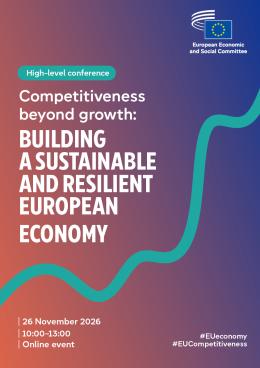
As Europe seeks to strengthen its competitiveness in an increasingly fragmented global economy, the challenge is not only to boost productivity and innovation, but also to preserve the foundations of its social market economy. This high-level conference will examine how the EU can mobilise savings and investment, maintain sustainable public finances, and deepen Economic and Monetary Union to support long-term growth, resilience and convergence.
In the context of the creation of a Savings and Investments Union that benefits EU citizens, financial literacy positions as an enabler. In this debate we put-together the voices of the European Commission and local organisations to exchange on their projects and policy proposals.
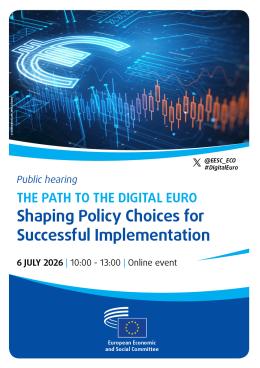
In the context of the work on the own-initiative opinion on the introduction of the digital euro, the ECO section decided to organise a public hearing bringing together experts from European and international institutions and various organised civil society.
This public hearing will gather policymakers and civil society stakeholders to discuss on how public banks can better support EU industrial policy, innovation, the scale-up of EU businesses, and, ultimately, economic growth.
This public hearing will bring together policymakers and civil society stakeholders to discuss on existing initiatives, the role that civil society should play, and what policy actions are necessary to untap their potential in this regard.