European Economic
and Social Committee
European Economic
and Social Committee
The European Economic and Social Committee (EESC) is the voice of organised civil society in Europe.
Find out more about its role and structure at http://www.eesc.europa.eu/en/about
The EESC issues between 160 and 190 opinions, evaluation and information reports a year.
It also organises several annual initiatives and events with a focus on civil society and citizens’ participation such as the Civil Society Prize, the Civil Society Days, the Your Europe, Your Say youth plenary and the ECI Day.
Find the latest EESC opinions and publications at http://www.eesc.europa.eu/en/our-work/opinions-information-reports/opinions and http://www.eesc.europa.eu/en/our-work/publications-other-work/publications respectively.
The EESC is active in a wide range of areas, from social affairs to economy, energy and sustainability.
Learn more about our policy areas and policy highlights at http://www.eesc.europa.eu/en/policies
The EESC holds nine plenary sessions per year. It also organises many conferences, public hearings and high-level debates related to its work.
Find out more about our upcoming events at http://www.eesc.europa.eu/en/agenda/our-events/upcoming-events
Here you can find news and information about the EESC'swork, including its social media accounts, the EESC Info newsletter, photo galleries and videos.
Read the latest EESC news http://www.eesc.europa.eu/en/news-media/news and press releases http://www.eesc.europa.eu/en/news-media/press-releases
The EESC brings together representatives from all areas of organised civil society, who give their independent advice on EU policies and legislation. The EESC's326 Members are organised into three groups: Employers, Workers and Various Interests.
Find out more about our Members and groups at http://www.eesc.europa.eu/en/members-groups
The EESC has six sections, specialising in concrete topics of relevance to the citizens of the European Union, ranging from social to economic affairs, energy, environment, external relations or the internal market.
Find out more at http://www.eesc.europa.eu/en/sections-other-bodies
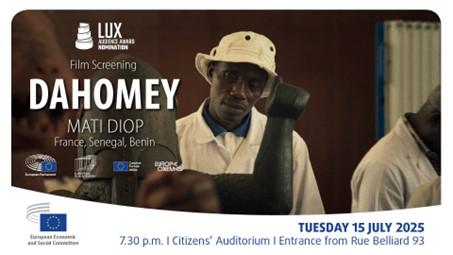
This summer's film screenings at the EESC continue with the screening of a Golden Bear winner which looks at France's efforts to confront its colonial past and make restitution. The film screenings are organised in collaboration with the LUX European Audience Film Award.
The European Economic and Social Committee has hosted the screening of Dahomey, a documentary by director Mati Diop and winner of the Golden Bear at the 74th Berlin Film Festival.
Dahomey tells the story of the return of 26 royal treasures, stolen by French colonial troops in 1892, from Paris to present-day Benin. For some students at the University of Abomey-Calavi, France's restitution efforts are seen as a drop in the ocean given the number of artefacts yet to be repatriated to their countries of origin.
French-Senegalese director Diop, known for the film Atlantique ('Atlantics'), which won the Grand Prix at the Cannes Film Festival in 2019, has masterfully woven elements of fiction into Dahomey, creating an immersive experience for the viewer.
The EESC regularly hosts film screenings as part of its ongoing support for European cinema and ongoing appreciation of the creative industries. Nominated for the 2025 LUX European Audience Film Award, Dahomey was shown on 15 July at the EESC's Citizens' Auditorium. (cwb)