European Economic
and Social Committee
European Economic
and Social Committee
The European Economic and Social Committee (EESC) is the voice of organised civil society in Europe.
Find out more about its role and structure at http://www.eesc.europa.eu/en/about
The EESC issues between 160 and 190 opinions, evaluation and information reports a year.
It also organises several annual initiatives and events with a focus on civil society and citizens’ participation such as the Civil Society Prize, the Civil Society Days, the Your Europe, Your Say youth plenary and the ECI Day.
Find the latest EESC opinions and publications at http://www.eesc.europa.eu/en/our-work/opinions-information-reports/opinions and http://www.eesc.europa.eu/en/our-work/publications-other-work/publications respectively.
The EESC is active in a wide range of areas, from social affairs to economy, energy and sustainability.
Learn more about our policy areas and policy highlights at http://www.eesc.europa.eu/en/policies
The EESC holds nine plenary sessions per year. It also organises many conferences, public hearings and high-level debates related to its work.
Find out more about our upcoming events at http://www.eesc.europa.eu/en/agenda/our-events/upcoming-events
Here you can find news and information about the EESC'swork, including its social media accounts, the EESC Info newsletter, photo galleries and videos.
Read the latest EESC news http://www.eesc.europa.eu/en/news-media/news and press releases http://www.eesc.europa.eu/en/news-media/press-releases
The EESC brings together representatives from all areas of organised civil society, who give their independent advice on EU policies and legislation. The EESC's326 Members are organised into three groups: Employers, Workers and Various Interests.
Find out more about our Members and groups at http://www.eesc.europa.eu/en/members-groups
The EESC has six sections, specialising in concrete topics of relevance to the citizens of the European Union, ranging from social to economic affairs, energy, environment, external relations or the internal market.
Find out more at http://www.eesc.europa.eu/en/sections-other-bodies
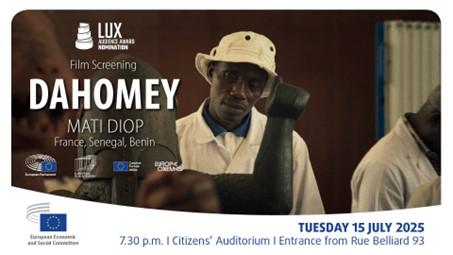
Les soirées cinématographiques estivales du CESE se poursuivent avec la projection d’un documentaire, lauréat de l’Ours d’or, qui s’intéresse aux efforts déployés par la France pour se confronter à son passé colonial et procéder à des restitutions. Ces projections sont organisées en collaboration avec le prix LUX du public.
Le Comité économique et social européen a accueilli la projection de Dahomey, un documentaire du réalisateur Mati Diop qui a remporté l’Ours d’or lors du 74e festival du film de Berlin.
Dahomey raconte l’histoire de 26 trésors royaux, volés par les troupes coloniales françaises en 1892, qui quittent Paris pour retourner dans ce qui est aujourd’hui le Bénin. Pour certains étudiants de l’université d’Abomey-Calavi, les efforts de restitution déployés par la France ne représentent qu’une goutte d’eau dans l’océan, étant donné le nombre d’objets qui doivent encore être rendus à leur pays d’origine.
Le réalisateur franco-sénégalais Mati Diop, qui s’est fait connaître avec le film Atlantique, lauréat du Grand Prix du Festival de Cannes en 2019, intègre avec brio des éléments de fiction dans Dahomey, créant ainsi une expérience immersive pour le spectateur.
Le CESE organise régulièrement des projections de films dans le cadre du soutien qu’il apporte sans relâche au cinéma européen et de l’appréciation qu’il manifeste en permanence à l’égard des industries créatives. La projection de Dahomey, nominé pour le prix LUX du public 2025, a eu lieu le 15 juillet. (cwb)