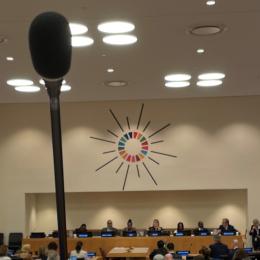
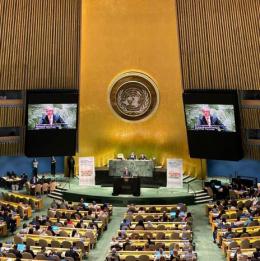
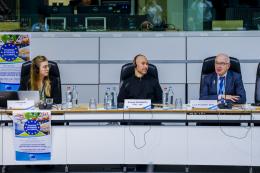
The SDG Summit was held on 18-19 September 2023 in New York with the aim to review the implementation of the 2030 Agenda for Sustainable Development and the 17 Sustainable Development Goals (SDGs). Peter Schmidt, President of the NAT section, attended the summit and called on the EU to redouble efforts and accelerate the implementation of SDGs.
This year again, as the advisory body representing Europe's organized civil society, the EESC engaged in the High-Level Political Forum on Sustainable Development (HLPF) to advocate for the voice of European citizens and promote sustainable development policies aligned with the EU's priorities.
The Civil Society Organisations' Group organised a photography exhibition in collaboration with the City of Culture of Galicia in the framework of its conference on EU food sovereignty: the role of agriculture, fisheries and consumers. The subject of the exhibition supported and complemented the Group's and the EESC's work on resilient and sustainable European food systems. The Group invited the Galician artist, Adrián Baúlde, to present parts of the series Mariscadoras.
At its March plenary session, the European Economic and Social Committee (EESC) hosted Ambassador Lachezara Stoeva, president of the United Nations Economic and Social Council (ECOSOC). Ambassador Stoeva strongly supported the key role civil society must play in implementing the 2030 Agenda.
On Tuesday 24 January, the European Economic and Social Committee (EESC) held an exchange of views with Guillaume Lafortune, Vice-President of the UN Sustainable Development Solutions Network (UN SDSN), on the implementation of the UN Sustainable Development Goals (SDGs). The debate revealed that the EU is failing to meet the objectives of the UN's 2030 Agenda. Yet, there is hope. The EU has the opportunity to take the lead, including through financial support. The EESC plays an important role in monitoring progress.
Transforming societies from fossil-fuel based to circular and sustainable will require far-reaching changes in all sectors, including education. In an own-initiative opinion, the European Economic and Social Committee (EESC) calls for transformative education that empowers young people to contribute to the green transition.
The EESC held a conference on the future of European strategic autonomy. The event was organised jointly by three Committee bodies; the Digital Transition and Single Market Observatory, the Labour Market Observatory and the Sustainable Development Observatory. Policy-makers, experts from organised civil society and academia, as well as youth representatives, gathered to discuss how to overcome current and future obstacles to a self-sufficient EU in times of great geopolitical tensions and multiple crises.
In two newly adopted opinions, the European Economic and Social Committee (EESC) gives updated views on the Commission's Annual Sustainable Growth Survey 2022, which outlines the upcoming economic and employment policy priorities for the EU, as well as on the Recommendations on euro area economic policy for 2022. The EESC calls for a balanced approach that does not jeopardise the EU's social and environmental goals.
The EESC is currently gathering inputs and views of diverse European actors working on the agenda 2030 for Sustainable Development. Civil society organisations who want to share their views on the EU’s internal and external implementation of the SDGs, are invited to submit their contribution via the online consultation.