European Economic
and Social Committee
European Economic
and Social Committee
The European Economic and Social Committee (EESC) is the voice of organised civil society in Europe.
Find out more about its role and structure at http://www.eesc.europa.eu/en/about
The EESC issues between 160 and 190 opinions, evaluation and information reports a year.
It also organises several annual initiatives and events with a focus on civil society and citizens’ participation such as the Civil Society Prize, the Civil Society Days, the Your Europe, Your Say youth plenary and the ECI Day.
Find the latest EESC opinions and publications at http://www.eesc.europa.eu/en/our-work/opinions-information-reports/opinions and http://www.eesc.europa.eu/en/our-work/publications-other-work/publications respectively.
The EESC is active in a wide range of areas, from social affairs to economy, energy and sustainability.
Learn more about our policy areas and policy highlights at http://www.eesc.europa.eu/en/policies
The EESC holds nine plenary sessions per year. It also organises many conferences, public hearings and high-level debates related to its work.
Find out more about our upcoming events at http://www.eesc.europa.eu/en/agenda/our-events/upcoming-events
Here you can find news and information about the EESC'swork, including its social media accounts, the EESC Info newsletter, photo galleries and videos.
Read the latest EESC news http://www.eesc.europa.eu/en/news-media/news and press releases http://www.eesc.europa.eu/en/news-media/press-releases
The EESC brings together representatives from all areas of organised civil society, who give their independent advice on EU policies and legislation. The EESC's326 Members are organised into three groups: Employers, Workers and Various Interests.
Find out more about our Members and groups at http://www.eesc.europa.eu/en/members-groups
The EESC has six sections, specialising in concrete topics of relevance to the citizens of the European Union, ranging from social to economic affairs, energy, environment, external relations or the internal market.
Find out more at http://www.eesc.europa.eu/en/sections-other-bodies
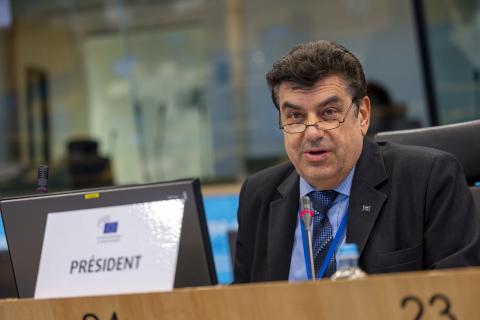
Ó mo thaobhsa de, mar chomhchathaoirleach ar Ardán Sochaí Sibhialta AE-na hÚcráine, is gá na naisc idir comhaltaí an Ardáin, a dhéanann ionadaíocht ar fhostóirí, oibrithe agus eagraíochtaí neamhrialtasacha, a athbhunú agus a chaomhnú. Ag an am cinniúnach seo, agus cogadh ar siúl san Úcráin, ní mór dúinn leanúint de bheith i dteagmháil le rannpháirtithe an Ardáin Sochaí Sibhialta ón Úcráin.
Má éiríonn linn naisc bhríomhara a choinneáil agus feidhmiú an líonra a áirithiú, is féidir linn dul chun cinn a dhéanamh maidir leis na tosaíochtaí. Faoi láthair, ba cheart é a bheith mar phríomhchuspóir riachtanais phraiticiúla mhuintir na hÚcráine a shainaithint agus féachaint conas is féidir linne, mar chomhaltaí d’Ardán Sochaí Sibhialta AE-na hÚcráine, cabhrú lenár gcomhghleacaithe san Úcráin trí ghníomhartha dlúthpháirtíochta sa chás fíordheacair seo.
Ach creidimse gurb é an cúram is tábhachtaí atá orainn ná cabhrú le lánpháirtiú dídeanaithe cogaidh ón Úcráin, toisc go bhfuil níos mó ná cúig mhilliún duine tar éis teitheadh go tíortha comharsanachta agus go tíortha Eorpacha eile. Ba cheart lánpháirtiú sóisialta agus eacnamaíoch dhídeanaithe na hÚcráine a bheith ar bharr ár gcláir oibre sa chruinniú atá ar na bacáin d’Ardán Sochaí Sibhialta AE-na hÚcráine. Ní mór dúinn bealaí a aimsiú trínar féidir le daoine fásta agus leanaí ón Úcráin a bheith mar chuid de struchtúr sóisialta agus eacnamaíoch na dtíortha éagsúla, d'fhonn tráma an chogaidh a leigheas. Ar ndóigh, nuair a bheidh an cogadh thart, is é an chéad chéim eile a bheidh romhainn ná cabhrú leis na daoine sin lánpháirtiú ar ais arís san Úcráin.
Seasaimid le muintir na hÚcráine agus thar ceann an Ardáin Sochaí Sibhialta seo léirímid ár ndlúthpháirtíocht iomlán leo.
Veselin Mitov, comhalta de CESE, comhchathaoirleach Ardán Sochaí Sibhialta AE-na hÚcráine