European Economic
and Social Committee
European Economic
and Social Committee
The European Economic and Social Committee (EESC) is the voice of organised civil society in Europe.
Find out more about its role and structure at http://www.eesc.europa.eu/en/about
The EESC issues between 160 and 190 opinions, evaluation and information reports a year.
It also organises several annual initiatives and events with a focus on civil society and citizens’ participation such as the Civil Society Prize, the Civil Society Days, the Your Europe, Your Say youth plenary and the ECI Day.
Find the latest EESC opinions and publications at http://www.eesc.europa.eu/en/our-work/opinions-information-reports/opinions and http://www.eesc.europa.eu/en/our-work/publications-other-work/publications respectively.
The EESC is active in a wide range of areas, from social affairs to economy, energy and sustainability.
Learn more about our policy areas and policy highlights at http://www.eesc.europa.eu/en/policies
The EESC holds nine plenary sessions per year. It also organises many conferences, public hearings and high-level debates related to its work.
Find out more about our upcoming events at http://www.eesc.europa.eu/en/agenda/our-events/upcoming-events
Here you can find news and information about the EESC'swork, including its social media accounts, the EESC Info newsletter, photo galleries and videos.
Read the latest EESC news http://www.eesc.europa.eu/en/news-media/news and press releases http://www.eesc.europa.eu/en/news-media/press-releases
The EESC brings together representatives from all areas of organised civil society, who give their independent advice on EU policies and legislation. The EESC's326 Members are organised into three groups: Employers, Workers and Various Interests.
Find out more about our Members and groups at http://www.eesc.europa.eu/en/members-groups
The EESC has six sections, specialising in concrete topics of relevance to the citizens of the European Union, ranging from social to economic affairs, energy, environment, external relations or the internal market.
Find out more at http://www.eesc.europa.eu/en/sections-other-bodies
En mi opinión, como copresidente de la Plataforma de la Sociedad Civil UE-Ucrania, es necesario restablecer y mantener los vínculos entre los miembros de la Plataforma, que representan a los empresarios, los trabajadores y las ONG. En este momento crucial en el que se libra la guerra en Ucrania, hemos de mantener los contactos con los participantes ucranianos de la Plataforma de la Sociedad Civil.
Si conseguimos mantener los vínculos activos y garantizar el funcionamiento de la red, podremos avanzar en las prioridades. Por el momento, el objetivo principal debe ser poner de relieve las necesidades prácticas del pueblo ucraniano y analizar de qué manera nosotros, en nuestra calidad de miembros de la Plataforma de la Sociedad Civil de la UE, podemos ayudar a nuestros colegas ucranianos mediante actos solidarios en esta situación de extrema dificultad.
Pero creo que nuestra tarea más importante es ayudar a la integración de los refugiados de guerra ucranianos, ya que más de cinco millones han huido a los países vecinos y a otros países europeos. La prioridad de nuestra agenda en la próxima reunión de la Plataforma de la Sociedad Civil UE-Ucrania debe ser la integración social y económica de los refugiados ucranianos. Tenemos que encontrar la manera de que los adultos y los niños ucranianos puedan incorporarse a la estructura social y económica de cada país para ayudar a curar el trauma de la guerra. Por supuesto, cuando la guerra haya terminado, nuestro siguiente paso será apoyar a estas personas a reintegrarse en Ucrania.
Estamos con el pueblo ucraniano y, como Plataforma de la Sociedad Civil, expresamos nuestra plena solidaridad.
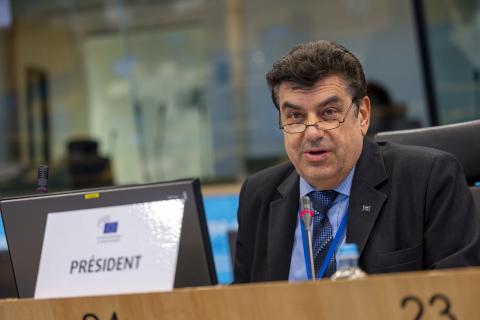
Veselin Mito, miembro del CESE, copresidente de la Plataforma de la Sociedad Civil UE-Ucrania