
European Economic
and Social Committee
In search of European prosperity innovation is key
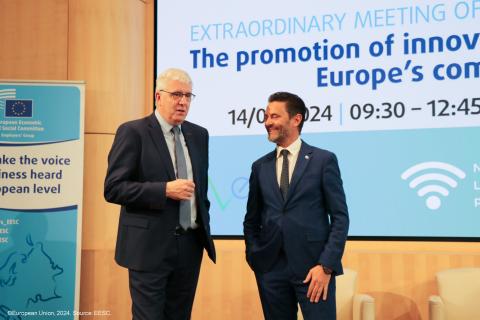
Article by Stefano Mallia (President of the EESC Employers' Group) and Pieter Timmermans (CEO of the Federation of Belgian Enterprises)
Economic growth is driven by innovation, modernization and research and development. It’s a message that countries such as the US and China have understood early on, and have invested heavily towards. Unfortunately it’s also exactly where the EU is losing ground to its global competitors.
Regulation hampers innovation
The reason why Europe is lagging behind is partly because of its imposed regulations which sometimes creates unexpected barriers for research and innovation. And translates directly into time, energy and money which they cannot invest in value creation and growth.
This is problematic since innovation is critical for achieving Europe's green and digital transitions towards sustainability and for strengthening Europe's competitiveness.
Therefore, strengthening the EU’s research and innovation performance should be a key strategic priority for the next European Commission between 2024-2029.
Initiatives must encourage innovation
To regain a global technological leadership position and bring more innovative products and services to market, the EU must firstly identify key strengths and weaknesses of the European innovation landscape, and develop a framework on how to best overcome them.
Secondly, Europe and its institutions should harness the principle of innovation and technology neutrality to guide policymaking, and base their approach on the broad scientific consensus.
A new Innovation Stress Test – as proposed by the Belgian Presidency of the Council - for the evaluation of each new legislation and policy initiative could then become an impactful instrument for enhancing the EU’s innovation ecosystem. It would be a practical and easily implementable guidance for policymakers to verify proposed legislation would not negatively impact Europe’s innovation efforts and competitiveness.
Of course, the tool will only be able to have a positive impact on European innovation if the European Commission systematically uses it and monitors its application. In addition, the tool could have an equally positive impact if used by policymakers in EU member states, and even at regional and local levels.
For a stronger Europe in the world, where it becomes the region of choice for entrepreneurship, innovation and investment, the EU must fully focus on promoting innovation in all its forms and make it one of the strategic priorities for the next European legislature of 2024-2029.
Recommended for you
Toghadh Séamus Boland ina Uachtarán ar Choiste Eacnamaíoch agus Sóisialta na hEorpa, agus gheall sé go gcuirfear an tsochaí shibhialta i gcroílár na hEorpa
News
Toghadh Séamus Boland na hÉireann ar an 35ú Uachtarán ar Choiste Eacnamaíoch agus Sóisialta na hEorpa (CESE) le haghaidh an téarma oifige 2025-2028. Is urlabhra riamh anall é do phobail na tuaithe…
CESE, Uachtarántacht na hÉireann agus an fhís choiteann atá acu
News
I ndiaidh na díospóireachta a reáchtáladh le Comhaltaí CESE le linn sheisiún iomlánach mhí Iúil, níl aon dabht faoi ach go bhfuil clár Uachtaránacht reatha an Aontais ag freagairt go mór do na…
#YEYS2022: Ceist na bréagaisnéise pléite ag aos óg na hEorpa agus a dtuairimí ina leith curtha in iúl acu don Leas-Uachtarán Jourová
News
Chuir daltaí meánscoile ó gach cearn den Eoraip ocht gcinn de thograí nithiúla faoi bhráid Leas-Uachtarán an Choimisiúin Eorpaigh um Luachanna agus um Thrédhearcacht, Věra Jourová. Bhí páirt á…
#CivilsocietyforUkraine
News
Cáineann CESE ionradh Rialtas na Rúise ar an Úcráin, ionradh atá gan údar agus gan chúis Rún ó Choiste Eacnamaíoch agus Sóisialta na hEorpa (CESE) maidir leis an gcogadh san Úcráin agus an tionchar…
Eagrán speisialta de CESE info
News
Eagrán speisialta de CESE info atá dírithe ar an Úcráin. Is féidir scéal Tetyana Ogarkova a léamh, bean a chuala fuaim ionradh na Rúise ar dhúiseacht di an 24 Feabhra.