
European Economic
and Social Committee
Poverty reduction: the EU needs poverty-proof policies
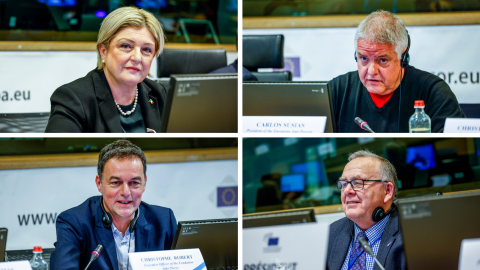
Poverty must always be combated in the EU and in the rest of the world. This is all the more important as the cost of living has increased significantly since the onset of the war in Ukraine. While civil society organisations provide important solutions to tackle the effects of poverty, it is clear that future policy measures must be poverty-proof. These are the conclusions of a discussion organised by the Civil Society Organisations' Group of the European Economic and Social Committee (EESC) on 22 March 2023. The event was attended by high-level guest speakers, including Italy's Minister for Labour and Social Policies, Marina Elvira Calderone.
Séamus Boland, president of the Civil Society Organisations' Group, stressed that, with one in five people in Europe still at risk of poverty or social exclusion in 2021[1], policymakers at all levels could not ignore the fact that poverty remained a problem in the EU. He added that The motto 'Leaving no one behind' must not lose its meaning
. Poverty was cited as the main reason for people being excluded from workplaces, education and basic health services. It was the single biggest cause of social exclusion and inequality.
In her speech, Ms Calderone emphasised that the fight against poverty required significant investment in social and professional networks to take people on a development journey that could upgrade human potential. It is essential to ensure that public authorities promote autonomous citizens' initiatives through appropriate legal frameworks that enable the development of new organisational forms,
said Ms Calderone. We all need to respond to the different forms of poverty and to the specific needs of the regions.
Carlos Susias, president of the European Anti-Poverty Network (EAPN), stressed the responsibility of governments and public institutions to combat poverty and social exclusion. He believes that social entities should be viewed as partners, collaborators and promoters. Policies to combat poverty or to address its consequences should be developed together with people who have experienced poverty and entities that work with them. Mr Susias added that social policies are decisive in avoiding the consequences of poverty, and economic and fiscal policies are essential in eradicating poverty
.
In this context, Christophe Robert, Executive Officer of France's Abbé Pierre Foundation, pointed out that, in addition to the high levels of people at risk of poverty and social exclusion and the 35 million people living in energy poverty in Europe in 2021, food inflation and the rise in property prices had had a major impact on the budgets of the most vulnerable households.
Every effort must be made to protect the households that are most in difficulty: combating homelessness, increasing minimum social benefits, preventing evictions, targeting and increasing energy support measures, banning electricity disconnections and more,
said Mr Robert. In this difficult context, civil society had an essential role not only in providing direct assistance where this fell within their remit, but also in shining a light on the difficulties of the most vulnerable and helping to reshape social protection in the Member States and across Europe as a whole.
During the Q&A sessions, several speakers emphasised the role of the social economy sector and asked for more support for the important work of civil society organisations. It was mentioned that:
- subsidies or a minimum income would not be enough to lift people out of poverty;
- social dialogue would need to lead to decent incomes and equality in pay;
- decent pensions and satisfactory minimum assistance in the areas of healthcare and housing would be necessary.
The latter played a significant role in social cohesion. Participants also called for targeted assistance, for instance for children, older people, minorities and self-employed people, and for measures to overcome obstacles in the job market, including training, reskilling and upskilling. With a view to the green transition and the digital transformation, changes in the job market and in working models had to be taken into account. The participants also suggested reviewing the distribution of wealth in European societies, for instance through progressive taxation policies that did not penalise businesses.
Background information:
'The fight against poverty, and the role of civil society organisations in combatting poverty', will continue to be the overriding priority of the Civil Society Organisations' Group after the first half of the EESC 2020-2025 term of office. This priority will apply both in 2023 and throughout the next 2.5-year term of office (beginning in April 2023). For further information on the Group's 2023 work programme, please visit our website at: 2023 Work Programme of the Civil Society Organisations’ Group | European Economic and Social Committee (europa.eu)
[1] This is equivalent to 95.4 million people, or 21.7% of the EU population in 2021 (Eurostat).
Work organisation
Downloads
-
PR - Poverty reduction: the EU needs poverty-proof policies
Recommended for you
Toghadh Séamus Boland ina Uachtarán ar Choiste Eacnamaíoch agus Sóisialta na hEorpa, agus gheall sé go gcuirfear an tsochaí shibhialta i gcroílár na hEorpa
News
Toghadh Séamus Boland na hÉireann ar an 35ú Uachtarán ar Choiste Eacnamaíoch agus Sóisialta na hEorpa (CESE) le haghaidh an téarma oifige 2025-2028. Is urlabhra riamh anall é do phobail na tuaithe…
CESE, Uachtarántacht na hÉireann agus an fhís choiteann atá acu
News
I ndiaidh na díospóireachta a reáchtáladh le Comhaltaí CESE le linn sheisiún iomlánach mhí Iúil, níl aon dabht faoi ach go bhfuil clár Uachtaránacht reatha an Aontais ag freagairt go mór do na…
#YEYS2022: Ceist na bréagaisnéise pléite ag aos óg na hEorpa agus a dtuairimí ina leith curtha in iúl acu don Leas-Uachtarán Jourová
News
Chuir daltaí meánscoile ó gach cearn den Eoraip ocht gcinn de thograí nithiúla faoi bhráid Leas-Uachtarán an Choimisiúin Eorpaigh um Luachanna agus um Thrédhearcacht, Věra Jourová. Bhí páirt á…
#CivilsocietyforUkraine
News
Cáineann CESE ionradh Rialtas na Rúise ar an Úcráin, ionradh atá gan údar agus gan chúis Rún ó Choiste Eacnamaíoch agus Sóisialta na hEorpa (CESE) maidir leis an gcogadh san Úcráin agus an tionchar…
Eagrán speisialta de CESE info
News
Eagrán speisialta de CESE info atá dírithe ar an Úcráin. Is féidir scéal Tetyana Ogarkova a léamh, bean a chuala fuaim ionradh na Rúise ar dhúiseacht di an 24 Feabhra.