
European Economic
and Social Committee
A stronger internal market through uniform digital taxation
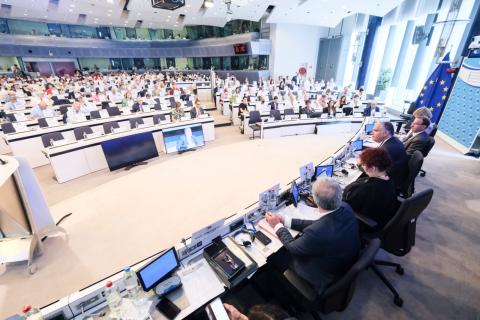
In an exploratory opinion, the European Economic and Social Committee (EESC) insists on the importance of coordinated European legislation establishing tax rates for digital service companies. This will ensure a growth-friendly business environment and benefit the internal market, while avoiding the gaps that separate national initiatives would create.
The Committee's opinion, drafted at the request of the Czech presidency of the Council of the European Union, states that any new rules must avoid double taxation and minimise compliance costs for businesses. While the EU can play a leading role in defining rules for taxing the digital economy, it should respect the international agreement reached by the OECD/G20.
Co-rapporteur Petru Dandea said: The EESC stresses that properly devised international tax laws on digital businesses are instrumental in preventing tax evasion and tax avoidance practices, as well as in designing a fair, stable and progressive taxation system.
Ensuring fair taxation in the digital era
Tax rules created before the internet era are allowing businesses with little or no physical presence in the EU, but whose customers are EU citizens, to pay less tax than traditional companies. This so-called base erosion and profit shifting reduces tax revenues in EU countries.
Pillars 1 and 2 of the OECD/G20 Inclusive Framework on Base Erosion and Profit Shifting are intended to ensure that companies providing digital services are taxed where their users and customers are located, to establish a minimum effective tax rate and discourage profit shifting.
The EESC considers that the two pillars should be seen as a comprehensive regulatory package.
Towards a more transparent taxation system
The Committee asks that the agreement to ensure fairer distribution of profits under Pillar 1 include the repeal of digital services taxes and similar measures. This would ensure a more stable international tax system and ease tensions between trading partners.
The EESC hopes that a viable EU and international agreement on Pillar 1 will be reached as soon as possible. The potential agreement should avoid overly complex rules and ensure transparency and predictability while keeping compliance costs low. An overcomplicated system could undermine the effectiveness of the new rules.
Once there is an agreement on Pillar 1, the EU should swiftly implement the corresponding rules in coordination with its major trading partners.
We feel that both Pillar 1 and Pillar 2 must be implemented within the EU as soon as it is feasible
, commented rapporteur Benjamin Rizzo. This will help achieve a high degree of consistency with the international agreement that will be negotiated by the OECD/G20.
Incorporating VAT
Once both pillars have been implemented, the EESC considers that services on platforms used by European consumers should be subject to VAT, an essential component of taxation in the digital economy.
The question is how VAT could be applied when digital communication services and social network customers use these services for no apparent charge. Digitalisation and automated reporting of information have allowed tax authorities and companies to save time and money. Data collection can be used to tackle underreporting, tax evasion and fraud. Software that submits sales data directly to tax authorities has already increased some countries' VAT revenues significantly.
VAT revenues represent an own resource for the EU budget and the EESC considers that digital services should also be included in the tax base.
Work organisation
Recommended for you
Toghadh Séamus Boland ina Uachtarán ar Choiste Eacnamaíoch agus Sóisialta na hEorpa, agus gheall sé go gcuirfear an tsochaí shibhialta i gcroílár na hEorpa
News
Toghadh Séamus Boland na hÉireann ar an 35ú Uachtarán ar Choiste Eacnamaíoch agus Sóisialta na hEorpa (CESE) le haghaidh an téarma oifige 2025-2028. Is urlabhra riamh anall é do phobail na tuaithe…
CESE, Uachtarántacht na hÉireann agus an fhís choiteann atá acu
News
I ndiaidh na díospóireachta a reáchtáladh le Comhaltaí CESE le linn sheisiún iomlánach mhí Iúil, níl aon dabht faoi ach go bhfuil clár Uachtaránacht reatha an Aontais ag freagairt go mór do na…
#YEYS2022: Ceist na bréagaisnéise pléite ag aos óg na hEorpa agus a dtuairimí ina leith curtha in iúl acu don Leas-Uachtarán Jourová
News
Chuir daltaí meánscoile ó gach cearn den Eoraip ocht gcinn de thograí nithiúla faoi bhráid Leas-Uachtarán an Choimisiúin Eorpaigh um Luachanna agus um Thrédhearcacht, Věra Jourová. Bhí páirt á…
#CivilsocietyforUkraine
News
Cáineann CESE ionradh Rialtas na Rúise ar an Úcráin, ionradh atá gan údar agus gan chúis Rún ó Choiste Eacnamaíoch agus Sóisialta na hEorpa (CESE) maidir leis an gcogadh san Úcráin agus an tionchar…
Eagrán speisialta de CESE info
News
Eagrán speisialta de CESE info atá dírithe ar an Úcráin. Is féidir scéal Tetyana Ogarkova a léamh, bean a chuala fuaim ionradh na Rúise ar dhúiseacht di an 24 Feabhra.