
European Economic
and Social Committee
Employers' Group and Polish presidency team up to shape a security-driven competitiveness
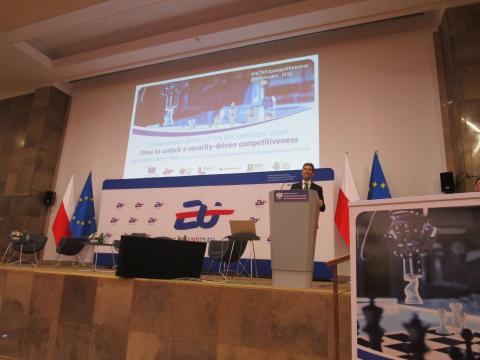
16 May 2025 - The EESC Employers' Group held an Extraordinary Meeting in Warsaw titled "Time to unlock a security-driven competitiveness", with the intent to underscore that security – broadly understood as economic, technological, energy, social, and geostrategic stability – is becoming a key component of competitiveness.
The event, co-organised in the framework of the Polish Presidency of the EU with Poland's Ministry of Development and Technology and our Polish members' organisations - Business Centre Club, Lewiatan Confederation, Employers of Poland, the Polish Craft Association, and the Union of Entrepreneurs and Employers – brought together employers and government leaders from all over Europe.
Group President Stefano Mallia opened the conference underlining that restoring Europe's competitiveness is not simply an economic necessity, it's a question of security, sovereignty, and survival.
"In the face of deepening rivalry between the United States and China, the European Union must develop its own sovereign path. Openness must not mean naivety. We therefore need to strengthen our position in critical and breakthrough technologies," stressed Polish Minister for Development and Technology Krzysztof Paszyk.
Europe stands at a strategic crossroads. On the one hand, there is a clear need for deepening economic integration, on the other it faces growing geopolitical threats, trade tensions, and intensifying competition from third countries. In this new context, security — understood broadly as economic, technological, energy, social, and geostrategic stability — has become an inseparable component of competitiveness, underlined speakers, which included Polish Secretary of State Michał Jaros, Małgorzata Darowska (Coordinator for EU Affairs at WB Group), Dr. hab. Grzegorz Brona (CEO of Creotech Instruments S.A), Henryk Orfinger (Chairman of the Supervisory Board of DR IRENA ERIS S.A).
Mallia insisted that strategic autonomy cannot be achieved without a strong industrial base, a well-functioning Single Market, and a regulatory environment that fosters investment and scaling up.
"This is not just a matter of ambition – it is a condition for the survival of the European economic and social model in the 21st century," echoed Minister Paszyk. "We must invest in innovation, while also protecting our know-how, critical infrastructure, and technological independence. This is why the economic dimension of security – including access to raw materials, energy, technology, infrastructure, and data – is so significant."
Companies like Creotech Instruments S.A. and WB Group said that in Poland they have developed world-class capabilities in satellite technologies, quantum computing applications, drones and defence, but fragmented markets, limited procurement and regulatory delays have made scaling up painfully slow.
Meanwhile, in the United States and China, similar companies benefit from far more integrated ecosystems, larger public procurement markets, and faster regulatory approvals. Clean tech start-ups raise three times less venture capital in Europe than their American counterparts.
For too long, we have been followers in disruptive technologies, the time has come to become leader and develop our disruptive solutions, if we don't want to lose competitiveness in a world where technology developments are accelerating, said Pietro De Lotto, President of the EESC Consultative Commission on Industrial Change (CCMI), mentioning the need for a truly European DARPA, the US Department of Defence research and development agency, responsible for the development of emerging technologies.
EU and government institutions should act as enablers for new technologies and incubation centres, said Dr. hab. Grzegorz BRONA, CEO of Creotech Instruments S.A., as that would allow start-ups to scale up. "The EU should function as the first customer, the way the US government does for advanced technologies."
During the panel on removing barriers in the internal market, Emilie Prouzet EESC Vice-President of the Single Market, Production and Consumption Section, underlined the multiple barriers in the Single Market, such as complexity, fragmentation and territorial constraints. But the lack of ownership of the internal market in the member states is possibly the most critical aspect, she said, anticipating that the new Strategy on the Single Market the Commission will propose next week, will focus also on measures to solve this problem with the real use of infringement procedures as well as the creation of a Single Market Sherpa.
The full list of speakers is available here with their bio notes.