Laajentumismaat

This page is also available in:

ETSK on aktiivisesti mukana EU:n laajentumisprosessissa ja on kehittänyt kaksitahoisen – alueellisen ja kahdenvälisen – lähestymistavan suhteilleen kansalaisyhteiskunnan organisaatioiden kanssa laajentumismaissa.

Alueellisen lähestymistavan yhteydessä Länsi-Balkanin seurantakomitea – joka on ETSK:n pysyvä sisäinen elin – on tärkein ETSK:n toimia tällä alueella koordinoiva väline. Kahden vuoden välein järjestettävä Länsi-Balkanin kansalaisyhteiskuntafoorumi on osa seurantakomitean työtä.

ETSK työskentelee myös kahdenvälisesti Länsi-Balkanin maiden ja Turkin kanssa. ETSK on perustanut näiden maiden ja EU:n välillä tehtyjen assosiaatiosopimusten pohjalta Turkin, Montenegron ja Serbian kanssa kolme yhteiselintä, joissa on mukana kansalaisyhteiskunnan edustajia, jotta kansalaisyhteiskunnan organisaatiot voisivat osallistua liittymistä edeltäviin prosesseihin ja liittymisprosesseihin. Kussakin elimessä on sama määrä jäseniä ETSK:sta ja kumppanimaista, ja ne kokoontuvat kahdesti vuodessa.

ETSK pitää säännöllisesti yhteyttä niiden laajentumismaiden kansalaisyhteiskunnan organisaatioihin, joiden kanssa ei ole vielä perustettu kansalaisyhteiskunnan edustajien yhteiselintä, ja järjestää niiden kanssa yhteistä toimintaa.

Yhteiselinten työtä täydentävät ETSK:n valmistelemat lausunnot yksittäisten maiden liittymistä edeltävistä prosesseista ja liittymisprosesseista sekä alueellisesti kiinnostavista aiheista.

  • Event type
    Debate

    EU enlargement is a key priority for the European Economic and Social Committee (EESC). The Committee considers enlargement to be a geostrategic investment in a strong, stable, secure and united Europe, grounded in shared democratic values.

  • Reference number
    26/2026

    A week ahead of the EU-Western Balkans summit, the European Economic and Social Committee held a conference in Vienna sending a clear message: civil society is essential for building trust between institutions and citizens and between the European Union and the region.

  • Event type
    JCC Meeting

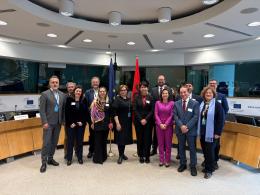
    The 3rd meeting of the EU–Albania Joint Consultative Committee (JCC) brought together representatives of organised civil society and social partners from Albania and the European Union to exchange views on Albania’s accession process.

  • Trust and Partnership at the Heart of EU Enlargement
    Event type
    Conference

    On 29 May 2026, the European Economic and Social Committee (EESC) organised a High‑Level Civil Society Conference that brought together EU and Western Balkans stakeholders to discuss the role of civil society in advancing EU enlargement, strengthening democratic resilience and supporting socio‑economic convergence in the region.

  • Event type
    JCC Meeting

    The 22nd meeting of the EU–Montenegro Joint Consultative Committee (JCC) was hold in Podgorica. The meeting brought together representatives of organised civil society from the European Union and Montenegro to exchange views on recent developments in EU–Montenegro relations and on key priorities in the EU accession process.

  • Published in
    16 pages

    Europe is facing a pivotal moment. Social and economic inequalities, rapid technological change, anti-democratic forces and geopolitical instability are straining the foundations of the European project.

    With democracy and civic space under mounting pressure, civil society organisations, human rights defenders and free media face growing constraints - from restrictive laws and disinformation campaigns to underfunding and public distrust. Deepening polarisation and eroding trust in institutions further undermine Europe’s democratic model.

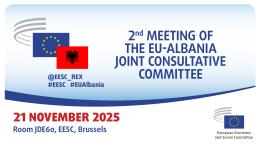
  • Albania remains firmly committed to EU integration, advancing accession negotiations and implementing the growth plan for the Western Balkans, with reforms in the rule of law, digitalisation and the green transition. However, anti-corruption and media freedom require further robust efforts. These topics were at the centre of discussions during the 2nd meeting of the EU-Albania Civil Society Joint Consultative Committee on 21 November 2025.

  • Event type
    JCC Meeting

    European Economic and Social Committee (EESC) and Montenegro held its 21st Civil Society Joint Consultative Committee (JCC) on 16 December 2025, at the EESC in Brussels, Belgium. This platform, established between the EESC and Montenegrin civil society, provides a civil society perspective within the EU institutional framework related to the Stabilisation and Association Agreement between the EU and Montenegro. The JCC enables civil society organisations from both sides to monitor Montenegro's accession negotiations, discuss common interests, and inform the public about the challenges during the accession period.

    @EESC_REX   |   #EUMontenegro    |    #EESC_WB

  • Event type
    JCC Meeting

    The second meeting of the EU-Albania Joint Consultative Committee (JCC) will took place on  21 November 2025 at the EESC in Brussels, Belgium. This platform, established within the institutional framework of the EU-Albania Stabilisation and Association Agreement (SAA), will enable representatives from both the EU and Albanian civil society to monitor the country's accession negotiations, discuss issues of common interest, and highlight concerns to be addressed on Albanian's path towards the European Union.

    @EESC_REX
    #EESC
    #EESCAlbania

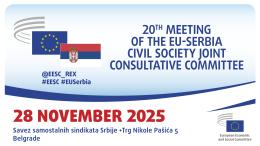
  • The EU-Serbia Joint Consultative Committee (JCC) held its 20th meeting on 28 November 2025 in Serbia. This platform, established within the institutional framework of the EU-Serbia Stabilisation and Association Agreement (SAA), will enable representatives from both the EU and Serbian civil society to monitor the country's accession negotiations, discuss issues of common interest, and highlight concerns to be addressed on Serbia's path towards the European Union.

    @EESC_REX
    #EESC
    #EESCSerbia