
European Economic
and Social Committee
Winning the hearts and minds of EU citizens on enlargement
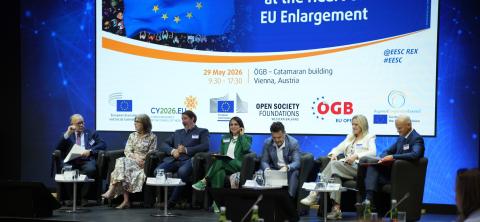
A week ahead of the EU-Western Balkans summit, the European Economic and Social Committee held a conference in Vienna sending a clear message: civil society is essential for building trust between institutions and citizens and between the European Union and the region.
According to the latest Eurobarometer, 53% of EU citizens are in favour of further EU enlargement, with support particularly high among young people. However, the support varies significantly per country.
Even though the political authorities in Austria firmly support enlargement, only 38% of its citizens are in favour. That is why Vienna was chosen as the host city for the conference to raise awareness of the benefits of EU enlargement among the Austrian public.
‘EU enlargement is a geopolitical imperative for a stronger, more secure and more prosperous Europe, but we can’t take the support of citizens in the EU or the Western Balkans for granted,’ said EESC President Séamus Boland. ‘Civil society must be at the heart of this process, building bridges between the EU and the Western Balkans and helping deliver the reforms and prosperity that enlargement can bring.’
Speakers pointed out that it is a communication challenge, not just a political one, because according to Eurobarometer, overall, two thirds of EU citizens say they do not feel well informed about enlargement. Therefore, clear evidence that enlargement strengthens Europe’s security, economy and democratic resilience needs to be presented, stressing that it brings tangible benefits to citizens both in the EU and in the Western Balkans.
Ulrike Hartmann, Special Envoy for Southeast Europe and EU Enlargement, Federal Ministry for European and International Affairs of the Republic of Austria, emphasised the role of reciprocal communication from Member States and candidate countries as a crucial way to rebuild trust and demonstrate the benefits of enlargement both ways. She concluded ‘Citizens of the Western Balkans have been waiting to join the EU for 23 years. We need to speed up this process to see new members before the end of the decade. Until then, we should apply the concept of gradual integration into the internal market of the EU, so citizens can directly feel the benefits of EU.’
In this connection, Wojciech Kowalski, Advisor on the Western Balkans at the European Commission’s Directorate-General for Enlargement and Eastern Neighbourhood, explained that communication and outreach in the Member States is essential. ‘Presenting achievements and showing how the EU acquis is implemented in the candidate countries helps us to communicate and convince the audience. In this way we can reassure the public that enlargement is a merit-based process,’ said Mr Kowalski.
Under the auspices of the Cyprus Presidency of the Council of the EU, the conference brought together more than 100 participants: Western Balkan stakeholders and representatives from the EU institutions and Austria’s civil society and government. It was organised in cooperation with the European Commission, the Open Society Foundation – Western Balkans (OSF-WB) and the Regional Cooperation Council (RCC).
Marilena Raouna, Deputy Minister for European Affairs, Cyprus Presidency of the Council of the EU, stressed in a video message that enlargement is a geopolitical necessity for the EU and a top priority for the Cyprus Presidency. ‘Enlargement is emerging as one of the EU’s most urgent priorities, not only as a policy choice but as a strategic imperative, as the strength of enlargement lies in its transformative power. It is a testament to the enduring capacity of our Union to evolve, integrate and unite.’
Speakers stressed that open and concrete discussions are needed between civil society representatives from the Western Balkans, Austria and other EU Member States to rebuild public trust in enlargement. Civil society must play a stronger role as a bridge between institutions and citizens.
Thomas Waitz, Member of the European Parliament, said: ‘Civil society is one of the most crucial pillars of the EU enlargement process and an important partner for me as a politician. Civil society must be firmly embedded in the reform process through a genuine and inclusive exchange and trusted to hold politics accountable.’
Participants highlighted the essential role of civil society, social partners and regional cooperation in strengthening democratic resilience, countering disinformation and supporting sustainable socioeconomic convergence with the EU.
Andi Dobrushi, Director of Open Society Foundations – Western Balkans, explained that enlargement should not be seen as a charity project but as a contributory project from the Western Balkans to the EU. He added that civil society organisations should be involved before the accession arrangements are finalised and not after. ‘As our experience in the region shows, the issue is not that civil society lacks evidence or expertise — our evidence is already in the room. The real gap is that we are often not. That is the difference between being consulted and being counted as a democratic partner in shaping enlargement policy,’ he said.
Wolfgang Katzian, President of the Austrian Trade Union Federation and President of the European Trade Union Confederation, underlined: ‘Successful Western Balkans enlargement requires more than economic integration. Without strong trade unions, robust social dialogue and proper funding, the EU risks creating more social dumping instead of shared prosperity.’
The conference conclusions will be sent to European Council President António Costa and the Cyprus Presidency for the EU-Western Balkans Summit in Montenegro on 5 June.
Work organisation
Downloads
-
Winning the hearts and minds of EU citizens on enlargement
Recommended for you
EU-Western Balkans Civil Society High-Level Conference: Trust and Partnership at the Heart of EU Enlargement
News
EU - Western Balkans Civil Society High Level Conference: Trust and Partnership at the Heart of EU EnlargementOn 29 May 2026, the European Economic and Social Committee (EESC) under the auspices of…
Enlargement and the EU agri-food sector
News
In the opinion, the EESC: Highlights that this unique enlargement, shaped by current geopolitical circumstances, should not undermine candidate countries' preparedness, necessary legislative…
President Boland in Moldova: advancing EU accession with civil society at the heart
News
On a mission to Moldova, European Economic and Social Committee (EESC) President Séamus Boland met with Moldova’s political leadership, civil society organisations and young people to reaffirm the…
EESC issues an early alert : implications of EU enlargement for agriculture
News
The European Union’s upcoming enlargement is poised to be a transformative event. It faces pressing global challenges, such as a new geopolitical environment, climate change and the just transitions…
Strong and inclusive cohesion policy is key to a successful EU enlargement
News
The European Economic and Social Committee (EESC) has adopted two opinions at its May plenary, emphasising the crucial role of cohesion policy – the EU’s primary funding instrument for regional…