In the context of the European Gender Equality Week and as part of its section meeting, the NAT section will host a public debate on gender equality and youth in rural areas.
The EESC is convinced that islands, mountainous regions and sparsely populated areas face significant challenges and that there is a solid legal basis that obliges the EU to take action in order to tackle these challenges. In this context, the organised civil society has an important role to play and through this debate, the aim is to find the best practices and solutions so that these regions can perform better and recover from the multiple crises. Therefore the EESC- ECO section has decided to organise this public debate in the framework of the EESC own-intiative opinion on "Main challenges that EU islands, mountain and sparsely populated areas face.
EESC, VMA Building, Room VMA 22, Rue Van Maerlant 2, 1000
Brussels
Belgium
The EESC will hold a hybrid hearing in Brussels on 9 November 2023 from 2:30 to 5:30 pm on "Young people and mental health"
In the event, we will discuss some of the factors affecting mental health of young generations, namely addiction to social media climate anxiety and other social determinants like working conditions. The objective will be to propose possible actions to protect mental health of young people and improve their wellbeing.
The sustainable economy we need - With Executive Vice-President Timmermans
Location
10:30 - 11:30 CEST - Webstreamed
Brussels
Belgium
Following the success of the previous Youth Climate and Sustainability Round Tables, the EESC will host the fourth EU Youth Round Table on Tuesday 18 July, 10:30-11:30 CEST. Frans Timmermans, Executive Vice-President for the European Green Deal, will participate in the event and will engage with the youth representatives on the topic: the sustainable economy we need for a successful implementation of the European Green and Social Deal.
Insularity is considered to be a permanent and unchangeable geographical feature which involves additional costs (transport, energy, waste management, public services, necessity goods and services) that hamper the development and competitiveness of the islands, while particularly exposing them to biodiversity loss and climate change. The organised civil society has an important role to play and tackle all these challenges and through this debate. The aim is to find the best practices and solutions so that EU islands can preform better and recover from the multiple crises.
The EESC is organising a hybrid public hearing to gather the view of youth representatives, rural development experts and various stakeholders on how to promote sustainable and inclusive rural development that benefits young people and rural communities as a whole.
How can these regions become drivers for growth and development?
Event type
Public hearing
Location
Umeå Folkets hus,
Skolgatan 59
Umeå
Sweden
The European Economic and Social Committee (EESC) will be producing an own-initiative opinion on the main challenges faced by EU islands and mountainous and sparsely populated areas, which is scheduled for adoption at the EESC's September plenary session. In this context, the EESC, along with the Conference of Peripheral Maritime Regions (CPMR) and the North Sweden European Office (NSEO), will be holding a public hearing in Umeå (Sweden) on 4 May 2023 entitled "Challenges and opportunities that the digital and energy transitions present to the northern sparsely populated areas and islands. How can these regions become drivers for growth and development?". The hearing is an event under the Swedish Presidency of the Council of the EU.
Interactio and Room JDE 60, EESC building, Rue Belliard 99, 1040
Brussels
Belgium
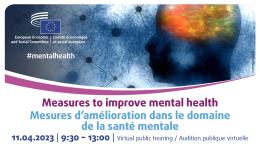
In order to prepare the exploratory opinion requested by the future Spanish presidency of the EU on "Measures to improve mental health", the EESC is organising a hybrid public hearing on 11 April 2023 from 9:30 am to 1 pm.
The aim of the event is to gather input from policy makers, civil society organisations and social partners, which will feed into the EESC's opinion.
The Commission and the High Representative adopted in October 2022 the Joint communication Youth Action Plan in the European Union external action for 2022-2027, the first-ever policy framework for a strategic partnership with young people around the world to build a more resilient, inclusive and sustainable future. It will help deliver on international commitments, such as the United Nation's 2030 Agenda for Sustainable Development and the Paris Climate Agreement, by enhancing meaningful youth participation and empowerment in the EU's external action policies.
The Youth Action Plan (YAP) in EU External Action is guided by three pillars of action that will help shape the EU's partnership with young people in partner countries:
partnership to engage: increasing young people's voices in policy and decision-making;
partnership to empower: fighting inequalities and providing young people with the skills and tools they need to thrive;
partnership to connect: fostering opportunities for young people to network and exchange with their peers worldwide.
Hearing "YAP to youth worldwide: Next step – implementation!" in the framework of the EESC REX/566 opinion will focus on the implementation of YAP by hearing views of International Organisations, social partners and youth representatives from around the Globe.