
European Economic
and Social Committee
Connecting Europe Facility – EESC calls for strong increase in funding for energy and transport
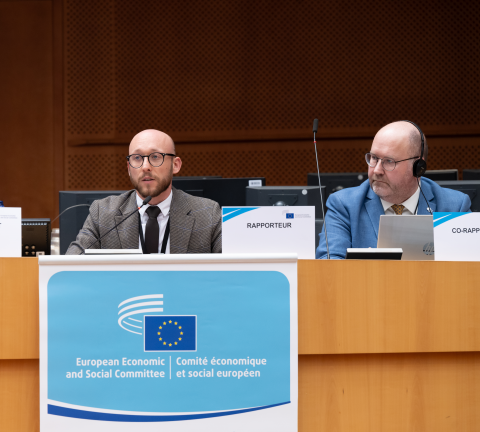
According to an opinion adopted at the January plenary, the EU key funding instrument should be reinforced with EUR 20 billion to make the implementation of cross-border investments in energy and transport a reality. This is essential to urgently strengthen the EU’s resilience and increase security.
The funding planned for energy and transport in the new Connecting Europe Facility (CEF) is insufficient and should be increased to at least EUR 100 billion for the period 2028-2034.
The European Economic and Social Committee (EESC) is pleased to note that the European Commission has recognised the need to invest in renewable energy projects and transport infrastructure in order to urgently strengthen the EU’s resilience and step up security. However, the earmarked budget is not enough, underlines the Committee in the opinion Connecting Europe Facility 2028-2034 drafted by Mateusz Szymański and Tomas Arvidsson.
‘The Connecting Europe Facility programme will play a key role in building the EU’s resilience,’ said Mr Szymański. ‘We therefore call for an increase in funding, the rapid definition of eligibility criteria that take into account the social dimension of investments, and priority treatment for regions that are most vulnerable to provocations and attacks from hostile countries as Russia and Belarus’.
Investing in regions with infrastructure gaps
In the opinion, the EESC points out that the CEF programme should prioritise investments in regions with significant infrastructure gaps both in transport and energy. The objective is to ensure territorial cohesion and full use of the single market.
The CEF should focus even more strongly on cross-border investments than in the past, without ruling out investments implemented within a single Member State if they meet the needs and objectives of the CEF and are significant for Trans-European Networks for Transport (TEN-T) and Trans-European Networks for Energy (TEN-E).
Areas with missing links in the TEN-T and insufficient capacity in the TEN-E must be a priority, with the end goal of removing infrastructure bottlenecks. Against this backdrop, in order to achieve best possible results, it is essential to strengthen coordination mechanisms at various levels and so avoid gaps and overlaps between different projects.
In the next programming period, it might also be appropriate to include investments extending beyond the EU, through the expansion of TEN-T corridors to candidate countries, but funding should remain focused on EU-based projects.
Linking funding to social and environmental criteria
In order to ensure equal access, transparency and predictability of the CEF programme, the EESC is of the view that the new legislation should clarify which projects will be prioritised. On this matter, the Committee recommends introducing eligibility criteria which highlight projects enabling the urgent development of the EU’s capacity to build resilience and preparedness against threats, including from hostile countries.
CEF funding should be granted to projects which fulfil social and environmental criteria and create added value for the European Union. For geopolitical reasons, the EESC views shorter supply chains as a sensible goal to pursue.
In addition, in order to build the EU’s resilience and preparedness to respond to emerging threats, the Committee adds that it is crucial for the CEF to support projects which can secure critical infrastructure. This applies in particular to countries benefitting from EU cohesion policy and regions bordering hostile countries such as Russia and Belarus.
The CEF must also include rules to monitor all expenditures implemented through the programme, in particular for mid-term and ex-post assessment. The involvement of civil society and social partner organisations in the evaluation procedure can guarantee that decision-making processes related to CEF activities are transparent. ‘Organised civil society and social partners represent a unique source of information on the situation at various levels, including local communities,’ said Mr Arvidsson. ‘For this reason, cooperation with and attention to the voice of NGOs and social partners is crucial to ensure that projects deliver high social and economic added value.’
Background - Connecting Europe Facility
On 16 July 2025, the Commission adopted a proposal for the 2028-2034 Multiannual Financial Framework which includes a financial envelope of EUR 81 428 000 000 for the Connecting Europe Facility. This budget is earmarked for investments in trans-European networks for transport and energy infrastructure, including military mobility and renewable energy projects.
In light of increasing risks linked to natural and technological hazards, evolving security threats, and other disruptions, the EU must ensure that investments under the CEF are risk-informed and disaster resilient, in line with the objectives of the EU Preparedness Union Strategy.
The Connecting Europe Facility is a key EU funding instrument to promote growth, jobs and competitiveness through targeted infrastructure investments at European level.
The CEF for Energy is the EU funding programme to implement the Trans-European Networks for Energy policy. The objective is to support investments in building new cross-border energy infrastructure in Europe or rehabilitating and upgrading the existing one.
The CEF for Transport is the funding instrument for European transport infrastructure policy. It aims to support investments in building new transport infrastructure in Europe or rehabilitating and upgrading the existing one.
Work organisation
Recommended for you
Connecting Europe Facility - 2028-2034
News
BackgroundOn 16 July 2025, the Commission adopted a proposal for the 2028-2034 Multiannual Financial Framework which includes a financial envelope of EUR 81 428 000 000 for the Connecting Europe…
Connecting Europe Facility - 2028-2034
Opinion
Key pointsThe EESC:welcomes the recognition of the need for investments, in particular the urgent need to strengthen the EU’s resilience and improve security. The Committee demands for an increase in…
EESC calls for strong, streamlined regulation of crypto-assets
News
The European Economic and Social Committee backs increased regulation of crypto-assets, with robust, coherent rules to better protect investors across the EU in line with current measures applied to…
Energy connectivity, electricity grids
News
BackgroundThis exploratory opinion aims to analyse how the EU can improve the integration, reliability and sustainability of its energy infrastructure.More specifically, the opinion looks into…
EESC welcomes increased Horizon EU budget but calls for stronger governance
News
EU's expanded budget envelope for Horizon Europe sends a strong political signal underscoring Europe's ambition to strengthen competitiveness and strategic autonomy, EESC saysThe European Economic…