
European Economic
and Social Committee
Belarus: Repression, Resistance, and the Fight for Trade Union Rights
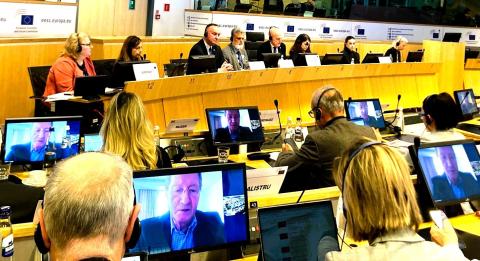
The External Relations Section (REX) of the European Economic and Social Committee (EESC) held a debate on 23 February 2026 to address the alarming deterioration of trade union freedoms in Belarus. Despite sustained international pressure and the appointment of an International Labour Organization (ILO) Special Envoy in June 2025, the Belarusian authorities continue to refuse any dialogue aimed at restoring compliance with fundamental labour standards. Around twenty trade unionists remain imprisoned.
The debate brought together representatives from EU institutions and international organisations, including Michał Kobosko, Co-chair of the European Parliament’s Delegation for relations with Belarus; Aymeric Dupont, Deputy Head of the Moldova, Belarus, Georgia, Armenia and Azerbaijan Division at the European External Action Service; Bogdana Sybikowska from the European Commission’s DG HOME; and the ILO Special Envoy for Belarus, Lelio Bentes Corrêa.
A central moment of the discussion was the testimony of Aliaksandr Yarashuk, Chairman of the Belarusian Congress of Democratic Trade Unions, who was recently released from prison and forcibly deported to the EU. His personal account shed light on the harsh conditions faced by detained trade unionists and the continued challenges confronting those released. Stripped of his identity documents following deportation, Mr Yarashuk highlighted the precarious legal situation of former political prisoners in EU Member States, who often struggle to regularise their status and access basic rights.
Describing the system of governance in Belarus as “extremely cruel and vindictive”, Mr Yarashuk stated that even after his release he continues to cope with the consequences of deportation and confiscation of documentation. He warned that Belarus has become “one of the ten most dangerous countries for workers and trade unionists”, noting that the authorities effectively eliminated the remaining trade union freedoms in 2022 through prison sentences and repression.
REX section President Stefano Palmieri underlined: "Despite several releases of political opponents the situation remains difficult. Beyond the detention of people there are also new forms of repression such as the removal of children from the families of targeted trade unionists".
The Committee has steadily increased its engagement with Belarusian civil society in exile and with political prisoners since the fraudulent presidential election of August 2020. This has included statements, opinions drafted in cooperation with Belarusian experts, debates, and an online exhibition. The Committee’s solidarity efforts gained renewed momentum in June 2025 with the signing of a Memorandum of Understanding with the Belarusian democratic forces.
Violations of fundamental labour rights, in particular freedom of association and collective bargaining is not a new reality in Belarus. The systematic pattern of repression has been going on for 20 years with the government failing to implement the recommendations of the Commission of Inquiry. In 2023 the International Labour Organization invoked Article 33 of its Constitution in relation to Belarus — a rare and serious measure used when a Member State persistently fails to comply with the recommendations of a Commission of Inquiry. This action calls on ILO Member States, including EU Member States, to take measures—such as limiting trade, financial and technical cooperation—to force Belarus to comply with the Commission of Inquiry's recommendations regarding violations of freedom of association Conventions.
The ILO Special Envoy Lelio Bentes Corrêa explained that his mandate included engaging with the authorities to ensure the release of detained trade unionists and recognition of the legal standing of independent trade unions. " However, the Belarusian authorities have so far refused to recognise my mandate or enter into dialogue. To date, around twenty trade unionists remain imprisoned, while their families continue to face intimidation and pressure" said Mr Corrêa.
Participants concluded that the objectives remain clear: to secure the release of all imprisoned trade unionists, restore freedom of association, and re-establish independent trade unions in Belarus. Mr Corrêa called for the support of all civil society organisations as their contribution is key in influencing the Belarusian authorities.
Work organisation
Downloads
-
Belarus: Repression, Resistance, and the Fight for Trade Union Rights