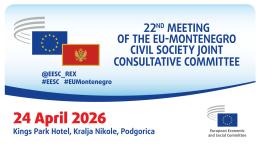
The 22nd meeting of the EU–Montenegro Joint Consultative Committee (JCC) was hold in Podgorica. The meeting brought together representatives of organised civil society from the European Union and Montenegro to exchange views on recent developments in EU–Montenegro relations and on key priorities in the EU accession process.
European Economic and Social Committee (EESC) and Montenegro held its 21st Civil Society Joint Consultative Committee (JCC) on 16 December 2025, at the EESC in Brussels, Belgium. This platform, established between the EESC and Montenegrin civil society, provides a civil society perspective within the EU institutional framework related to the Stabilisation and Association Agreement between the EU and Montenegro. The JCC enables civil society organisations from both sides to monitor Montenegro's accession negotiations, discuss common interests, and inform the public about the challenges during the accession period.
Accelerating Socio-Economic Convergence with the EU for a Better Life
-
Location
Hotel Splendid Conference & Spa Resort
Bečići bb
Budva
Montenegro
The 10th Western Balkans Civil Society Forum took place in Montenegro on 13-14 May 2024. The forum was hold in Montenegro to encourage the country to fulfil its ambition of becoming the next EU member state by 2028 and to serve as a positive example for the rest of the region. This event will represent a significant contribution from organised civil society to the European Commission's 2025 Enlargement Package.
On 20 March 2025, the European Economic and Social Committee (EESC) and Montenegro convened the 20th Civil Society Joint Consultative Committee (JCC) in Podgorica. This platform, established between the EESC and Montenegrin civil society, provides a civil society perspective within the EU institutional framework related to the Stabilisation and Association Agreement between the EU and Montenegro. The JCC enables civil society organisations from both sides to monitor Montenegro's accession negotiations, discuss common interests, and inform the public about the challenges during the accession period.
For the 19th time, the European Economic and Social Committee (EESC) and Montenegro held the Civil Society Joint Consultative Committee (JCC) in at the EESC in Brussels on 27 November 2024. The JCC is a civil society platform established between the EESC and Montenegrin civil society. It complements with a civil society point of view the EU institutional framework related to the Stabilisation and Association Agreement between the EU and Montenegro. This joint institution allows civil society organisations on both sides to monitor the country's accession negotiations. It is also a platform to discuss issues of common interest and to inform the public at large on the challenges ahead during the accession period.
Main topics of the 19th meeting of the EU-Montenegro JCC were:
Current state of play in EU-Montenegro relations: 2024 Enlargement Package and Montenegro Report, overview of the developments within the Berlin process
Reform Agenda (RA) for Montenegro and the implementation of the New growth plan for the Western Balkans
Montenegrin roadmap for fulfillment of the negotiation chapters’ closing benchmarks after the IBAR
Overview of the civil society situation in Montenegro, including social dialogue
Stara zgrada Vlade Crne Gore
Ulica Jovana Tomaševića bb
Podgorica
Montenegro
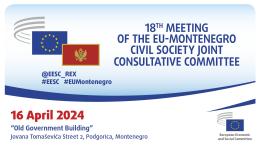
For the 18th time, the European Economic and Social Committee (EESC) and Montenegro held the Civil Society Joint Consultative Committee (JCC) in Podgorica on 16 April 2024. The JCC is a civil society platform established between the EESC and Montenegrin civil society.
For the 17th time, the European Economic and Social Committee (EESC) and Montenegro held the Civil Society Joint Consultative Committee (JCC) in Brussels on 7 December 2023. The JCC is a civil society platform established between the EESC and Montenegrin civil society. It complements with a civil society point of view the EU institutional framework related to the Stabilisation and Association Agreement between the EU and Montenegro. This joint institution allows civil society organisations on both sides to monitor the country's accession negotiations. It is also a platform to discuss issues of common interest and to inform the public at large on the challenges ahead during the accession period.
The External Relations Section (REX) of the European Economic and Social Committee (EESC) is responsible for dialogue between European civil society organisations and their homologues from the countries with which the European Union has formal relations (e.g. under the form of a Free Trade Agreement). Through this dialogue, made possible by a series of bilateral bodies, and through specialized opinions and information reports, the Committee is able to concretely contribute to EU foreign policy.