Opinion on the Proposal for a Regulation of the European Parliament and of the Council on certain procedures for applying the Stabilisation and Association Agreement between the European Communities and their Member States, of the one part, and the Republic of Montenegro, of the other part (codification)
Download — Stabilisation and Association Agreement between the European Communities and their Member States, of the one part, and the Republic of Montenegro, of the other part
This own-initiative opinion will draw upon the first-hand experiences of the non-state actors (civil society, business and trade unions) engaged in the accession negotiations between Croatia and the EU over the period 2005-11, as well as experiences of EESC members who have been engaged in the work of Joint Consultative Committees (JCCs) with accession countries over the past seven years (Croatia, the former Yugoslav Republic of Macedonia, Turkey and Montenegro) as well as the Western Balkans Follow-up Committee.
Download — Enhancing the transparency and inclusiveness of the EU accession process
Members of the European Economic and Social Committee (EESC) and representatives of the Montenegrin organised civil society held on the 1st March the 14th meeting of the EU-Montenegro Joint Consultative Committee (JCC), which took place online. Members of the JCC adopted a joint declaration urging the EU to assist Montenegro to face the devastating consequences of the COVID-19 pandemic in the country.
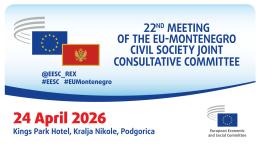
The 22nd meeting of the EU–Montenegro Joint Consultative Committee (JCC) was hold in Podgorica. The meeting brought together representatives of organised civil society from the European Union and Montenegro to exchange views on recent developments in EU–Montenegro relations and on key priorities in the EU accession process.
European Economic and Social Committee (EESC) and Montenegro held its 21st Civil Society Joint Consultative Committee (JCC) on 16 December 2025, at the EESC in Brussels, Belgium. This platform, established between the EESC and Montenegrin civil society, provides a civil society perspective within the EU institutional framework related to the Stabilisation and Association Agreement between the EU and Montenegro. The JCC enables civil society organisations from both sides to monitor Montenegro's accession negotiations, discuss common interests, and inform the public about the challenges during the accession period.
Accelerating Socio-Economic Convergence with the EU for a Better Life
-
Location
Hotel Splendid Conference & Spa Resort
Bečići bb
Budva
Montenegro
The 10th Western Balkans Civil Society Forum took place in Montenegro on 13-14 May 2024. The forum was hold in Montenegro to encourage the country to fulfil its ambition of becoming the next EU member state by 2028 and to serve as a positive example for the rest of the region. This event will represent a significant contribution from organised civil society to the European Commission's 2025 Enlargement Package.
On 20 March 2025, the European Economic and Social Committee (EESC) and Montenegro convened the 20th Civil Society Joint Consultative Committee (JCC) in Podgorica. This platform, established between the EESC and Montenegrin civil society, provides a civil society perspective within the EU institutional framework related to the Stabilisation and Association Agreement between the EU and Montenegro. The JCC enables civil society organisations from both sides to monitor Montenegro's accession negotiations, discuss common interests, and inform the public about the challenges during the accession period.