The EESC strongly believes in the importance of the next Semester cycle as a key instrument for implementing the Recovery and Resilience Facility.
However, it is still concerned about the lack of clarity in most Member States as regards their National Recovery and Resilience Plan governance systems and the distribution of responsibilities for their implementation.
The EESC would also draw attention to the need to measure progress in implementation, for which good monitoring indicators are needed; in this connection it welcomes the "Recovery and Resilience Scoreboard" initiative.
Moreover, the COVID-19 crisis has highlighted the need for a strong industrial policy to avoid dependence on other economic zones for many products and services.
The EESC wants to see real action in this respect by Member States, in terms of investment in education, infrastructure and industrial policy to raise employment and boost European industry.
The Conference on the Future of Europe offers a unique opportunity to improve the Union's ability to deal with these issues, not least by involving social partners and EU citizens who can offer concrete insights into their actual needs and expectations.
Climate protection and the pandemic have placed the State and Governments in a strong position. The European Commission has received a mandate from the governments of all EU member states to achieve climate neutrality for Europe by 2050 with the Green Deal, and to successfully lead the economy out of the Covid-19 crisis. A dynamic change of course is necessary. To protect workers during this transformation process, their rights have to be highlighted and enshrined as a special pillar at EU level.
It is time to translate the principles of the European Pillar of Social Rights (EPSR) into action, and Europe needs a new social contract for the future. This is the key message of the webinar on the Action Plan to implement the European Pillar of Social Rights and the Social Summit. The event was organised by the Workers' Group at the European Economic and Social Committee.
Europe is facing the greatest crisis in decades, in terms of public health, but also in economic and social ones. Overcoming it will only be possible with a strong social agenda.
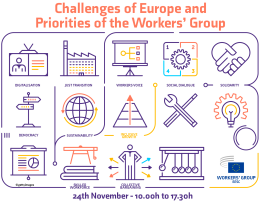
The Workers' Group is organising an extraordinary meeting on the current challenges for Europe and the priorities of the Workers' Group in this framework.
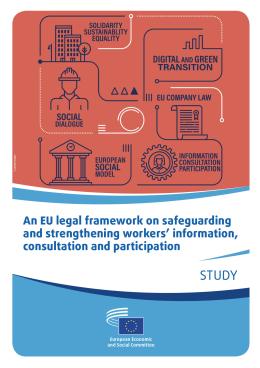
This study provides an overview of the current state of workers’ information, consultation and (board-level) participation in the European Union which are a key element of the Social Model as enshrined in the EU Treaties and a comprehensive body of secondary law.
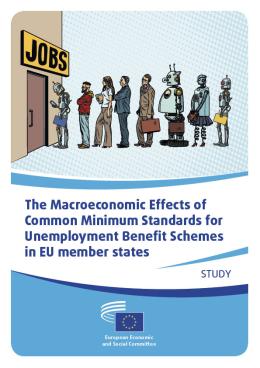
This study examines the impact on the automatic stabilisation properties of national unemployment benefit systems of a European policy initiative that would introduce minimum standards to those systems.