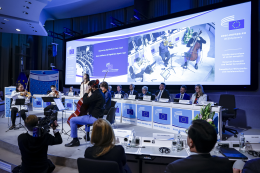
583rd plenary session: Celebration of the 65th anniversary of the European Economic and Social Committee; The Conclusions of the Spanish Presidency of the EU; Global climate commitments: reflecting on the outcomes of United Nations Framework Convention on Climate Change (UNFCCC) COP28.
As in the previous years, the European Economic and Social Committee (EESC) will actively take part in the annual United Nations Framework on Climate Change – COP28, which this year will take place in Dubai, United Arab Emirates, from 30 November until 12 December 2023. This year's COP marks the 31st anniversary of the adoption of the United Nations Framework Convention on Climate Change.
Consumers in the digital world: safeguarding youth and enforcing laws
Event type
Conference
Location
Room JDE 62
Brussels
Belgium
The objective was to reflect on how to achieve more efficient enforcement of the existing consumer protection legislation and how to tackle the challenges posed by the digital realm, with a special focus on minors.
The first meeting of the EU-Moldova Domestic Advisory Group (DAG) in the new 2023-25 term, will take place on 8 December 2023. The DAG will elect a new chair, discuss the progress in implementing the Trade and Sustainable Development Chapter and make proposals for a work programme for the new term.
On 7 December 2023, the sixth meeting of the EU Domestic Advisory Group was held in a hybrid format. DAG members engaged in constructive discussions on key topics shaping the trade partnership between the European Union and Singapore.
The agenda included an introduction round, a report on recent joint meetings, insights on Singapore's strategic importance, updates on the implementation of the EU-Singapore Free Trade Agreement, and a discussion on ways of cooperation and the EU DAG's work priorities.
For the 17th time, the European Economic and Social Committee (EESC) and Montenegro held the Civil Society Joint Consultative Committee (JCC) in Brussels on 7 December 2023. The JCC is a civil society platform established between the EESC and Montenegrin civil society. It complements with a civil society point of view the EU institutional framework related to the Stabilisation and Association Agreement between the EU and Montenegro. This joint institution allows civil society organisations on both sides to monitor the country's accession negotiations. It is also a platform to discuss issues of common interest and to inform the public at large on the challenges ahead during the accession period.
The EESC´s Consultative Commission on Industrial Change (CCMI) is organising a debate on the maritime sector with different stakeholders from international organisations as well as the European Commission.
During the 11th meeting of the EU-Chile JCC, held physically in Santiago de Chile, the members discussed ways to strengthen our bilateral partnership in the rapidly evolving global political and economic circumstances. The aim was to "put people first", underlining the role of the civil society in promoting inclusive growth and tackling common challenges driven by economic shocks, climate change, instability, various threats to democracy and multilateral order. The JCC also exchanged views on the progress of the constitutional reform in Chile. Moreover, in view of the changes of the legal framework resulting from the modernization of the EU-Chile Association Agreement, participants discussed proposals concerning the role of the civil society and the status of the JCC following the transition.