
European Economic
and Social Committee
IN DEFENCE OF EUROPEAN VALUES: THE POWER OF CIVIL SOCIETY
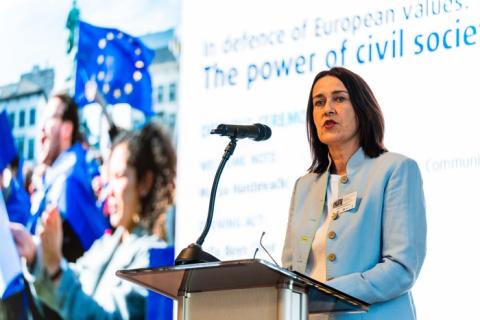
EESC Vice-President for Communication Marija Hanževački hosted the 18th edition of the Connecting EU seminar, the EESC’s flagship communication event, co-organised with the Economic and Social Council of Bulgaria and held in Sofia in July. She opens our coverage of the seminar by reflecting on its main discussions and conclusions.
On 6 and 7 July, we brought the Connecting EU seminar to the Bulgarian capital for two days of discussion on some of the most pressing matters facing Europe. Co-organised by the EESC and the Economic and Social Council of the Republic of Bulgaria and hosted by Sofia University St Kliment Ohridski, the seminar brought together EESC members and civil society communicators – communication and press officers from employers' associations, trade unions and civil society organisations, as well as journalists, researchers and representatives of EU and national institutions.
In the Focus section of this September issue of EESC Info, we bring you the highlights of this year’s Connecting EU seminar – whether you missed the event or simply want a recap.
This year’s theme, In defence of European values: The power of civil society, reflects the challenging times Europe is facing. The assumptions that have shaped our continent for decades are increasingly being called into question, both within and beyond our borders.
Europe faces growing security challenges and geopolitical tensions, mounting pressure to enhance its competitiveness, and increasingly serious threats to democracy.
Our first discussion focused on Europe’s new economic compass. We asked how Europe could align its efforts to strengthen the competitiveness of its economy with its hallmark social model and the environmental ambitions that have long set it apart. The presidents and representatives of the EESC’s three Groups – Sandra Parthie, Florian Marin and Cillian Lohan – opened the debate by discussing what a competitive, social and sustainable Europe should look like. The panel that followed brought together different views on regulation, workers’ living standards, environmental safeguards and the conditions Europe needs to build a stronger economy.
These questions cannot be separated from Europe’s place in the world. In his keynote address, journalist and author Dave Keating examined Europe’s dependence on the United States and argued that it must become more capable of shaping its own future. At a time when long-standing alliances are changing and economic and security dependencies are becoming increasingly risky, Europe needs to decide what greater sovereignty should mean in practice.
Our second major discussion turned to democracy. Foreign interference, disinformation, populism and the growing influence of online platforms are shaping what Europeans see and believe, and ultimately how they vote. The presentation of the report on TikTokcracy in the Balkans by the Balkan Free Media Initiative (BFMI) showed how algorithmic manipulation and coordinated networks of fake accounts can influence elections and exploit weaknesses in platform oversight.
We discussed whether fact-checking, media regulation and initiatives such as the European Democracy Shield are sufficient to counter these threats. But defending democracy is not only about fighting false information. It also means rebuilding trust, strengthening independent media and civil society, and communicating more convincingly how European democracy improves people’s lives.
There are good reasons not to give in to pessimism. More than half of Europeans continue to trust the EU, 57% are satisfied with the way democracy works at EU level and 73% see the Union as a place of stability in a troubled world. Democracy remains worth defending – and Europeans still believe in it.
On the second day, we turned from debate to practical tools. Our sessions on AI explored how artificial intelligence is transforming the way information is produced, shared and verified. Participants examined both its potential and its risks, from fact-checking and digital verification to the use of AI agents in everyday communication work. We concluded with a hands-on LinkedIn workshop on creating memorable content, building meaningful professional connections and using AI without losing one’s own voice.
We did not expect to solve all of Europe’s problems in two days. But I hope we left Sofia with a better understanding of the challenges ahead, new ideas and more effective ways of communicating about Europe. Civil society has an essential role to play – not only in defending European values, but also in ensuring that citizens can recognise their value in their everyday lives.
You can learn more about the Connecting EU 2026 on the event website where you can watch the recording of all the panels and sessions. They are also available on the EESC YouTube channel.