European Economic
and Social Committee
European Economic
and Social Committee
The European Economic and Social Committee (EESC) is the voice of organised civil society in Europe.
Find out more about its role and structure at http://www.eesc.europa.eu/en/about
The EESC issues between 160 and 190 opinions, evaluation and information reports a year.
It also organises several annual initiatives and events with a focus on civil society and citizens’ participation such as the Civil Society Prize, the Civil Society Days, the Your Europe, Your Say youth plenary and the ECI Day.
Find the latest EESC opinions and publications at http://www.eesc.europa.eu/en/our-work/opinions-information-reports/opinions and http://www.eesc.europa.eu/en/our-work/publications-other-work/publications respectively.
The EESC is active in a wide range of areas, from social affairs to economy, energy and sustainability.
Learn more about our policy areas and policy highlights at http://www.eesc.europa.eu/en/policies
The EESC holds nine plenary sessions per year. It also organises many conferences, public hearings and high-level debates related to its work.
Find out more about our upcoming events at http://www.eesc.europa.eu/en/agenda/our-events/upcoming-events
Here you can find news and information about the EESC'swork, including its social media accounts, the EESC Info newsletter, photo galleries and videos.
Read the latest EESC news http://www.eesc.europa.eu/en/news-media/news and press releases http://www.eesc.europa.eu/en/news-media/press-releases
The EESC brings together representatives from all areas of organised civil society, who give their independent advice on EU policies and legislation. The EESC's326 Members are organised into three groups: Employers, Workers and Various Interests.
Find out more about our Members and groups at http://www.eesc.europa.eu/en/members-groups
The EESC has six sections, specialising in concrete topics of relevance to the citizens of the European Union, ranging from social to economic affairs, energy, environment, external relations or the internal market.
Find out more at http://www.eesc.europa.eu/en/sections-other-bodies
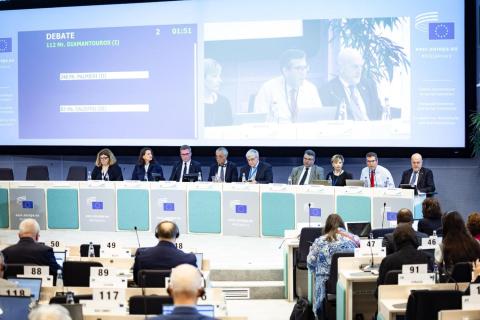
At its April plenary session, the EESC adopted the opinion The road to the next Multiannual Financial Framework in which that would provide the EU with the financial resources needed to achieve its political priorities.
In the opinion,drawn up by Elena-Alexandra Calistru, Konstantinos Diamantouros and Stefano Palmieri, the Committee stresses that the next Multiannual Financial Framework (MFF) must be strong and ambitious, and must be seen as an investment in delivering EU priorities and European public goods.
More specifically, the EESC is in favour of a significant, real-term increase in the MFF in order to address the huge challenges facing the EU. This means that the mechanism for adjusting the MFF in line with inflation, which has traditionally capped the annual increase in contributions to the budget at 2%, should change in order to preserve the real spending power of the MFF.
Speaking during the plenary debate, EESC president Oliver Röpke said that ‘In times of transition and uncertainty, Europe needs a future-proof budget that empowers us to act, protect and transform. We need an MFF that is an investment tool for European public goods. We need to mobilise investment to foster our green, blue, digital and social transitions’.
He continued by pointing out that ‘Simplification and accessibility of EU funding is crucial. The next MFF must streamline funding instruments, harmonise rules and reduce bureaucracy to deliver real results on the ground’. (mp)