Joint ECFIN-EESC Conference "The way forward for EU economic governance" will promote a horizontal discussion cutting across the various themes of the review of the economic governance framework, with debates on debt sustainability and growth, macro-economic imbalances, investment, and the implementation of the rules. It will gather a great line-up of speakers, including Christa Schweng, President of the European Economic and Social Committee, and Paolo Gentiloni, Commissioner for Economy.
A proposed review of EU banking rules aims at ensuring that EU banks become more resilient to potential future economic shocks, while contributing to Europe's recovery from the COVID-19 pandemic and the transition to climate neutrality. The public hearing will provide the views of institutional and civil society stakeholders, and will help form the policy recommendations the EESC is drawing up on the legislative proposals currently under discussion.
GDP is the best-known measure of macro-economic activity. While it is used both by policy-makers around the world and in public debates, it was not designed to be a comprehensive measure of prosperity and well-being. Thus, other indicators are needed to assess and address the global challenges of the 21st century such as climate change, poverty, resource depletion and to promote health and a higher quality of life. Beyond GDP indicators should become instruments to not only monitor and measure, but also to inform policy development, improve communication and encourage target setting. Against this background, the Section for Economic and Monetary Union and Economic and Social Cohesion (ECO) of the European Economic and Social Committee (EESC) is currently working on an own-initiative opinion on 'Beyond GDP measures for a successful recovery and a sustainable and resilient EU economy'.
The conference "The Anti-Money Laundering Legislative Package" will take stock of the state of play and debate in particular the legislative proposals tabled by the European Commission in July 2021 to strengthen the EU's anti-money laundering and countering terrorism financing (AML/CFT) rules.
The conference is organised on 5 October 2021, starting at 14:30.
The event is accessible via webstream. No registration is needed, and participation is free of charge.
Both a sustainable economic and social recovery from the COVID-19 crisis and the need to address effectively the climate change will require a massive expansion of investments. To achieve this, reshaping the EU fiscal rules is indispensable. Against this background, the Section for Economic and Monetary Union and Economic and Social Cohesion (ECO) of the European Economic and Social Committee (EESC) is currently working on an own-initiative opinion on Reshaping the EU Fiscal Framework for a Sustainable Recovery and a Just Transition.
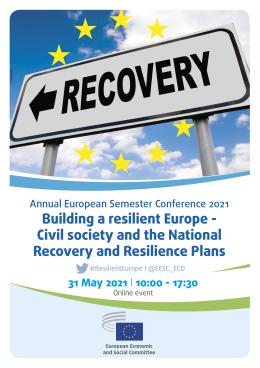
Building a resilient Europe - Civil society and the National Recovery and Resilience Plans
Event type
Conference
Location
Brussels
Belgium
The Recovery and Resilience Facility is moving into its next phase, and the European Semester Group of the EESC is following the process. In this high-level conference we will discuss whether the national recovery and resilience plans will deliver as regards the aim of achieving fair, inclusive, competitive and sustainable growth and cohesion through the new growth strategy – the European Green Deal. Focus will be on the implementation of the national recovery and resilience plans, with particular attention on the implementation of the European Pillar of Social Rights and the just transition towards a green, digital and sustainable European economy. The conclusions of this event will be forwarded to EU institutions and the "EU Recovery Summit" conference in Lisbon on 28 June 2021.
Following the outbreak of the COVID-19 pandemic, the European Economic and Social Committee (EESC) played a central role in bringing the consensual views of organised civil society in the EU to the attention of policy-makers and contributing to the rapidly evolving economic policy response at European level.
In this regard, we believe that now is the time for the EU institutions to make decisive steps in approving swiftly the new Facility and putting in place the necessary implementation mechanisms at European and national level, so that the hardest hit Member States, citizens and businesses can benefit from the relevant EU funding when they need it most.
Against this background, and on the occasion of the first meeting of the EESC's Section for Economic and Monetary Union and Economic and Social Cohesion (ECO) in our new term-of-office (2020-2025), we are organising a thematic debate on this issue between European policy-makers and civil society representatives.
The debate will take place on Thursday, 19 November 2020 from 14.30 to 16.40 as an online event, webstreamed live on the EESC website.
Europe is facing a pivotal moment. Social and economic inequalities, rapid technological change, anti-democratic forces and geopolitical instability are straining the foundations of the European project.
With democracy and civic space under mounting pressure, civil society organisations, human rights defenders and free media face growing constraints - from restrictive laws and disinformation campaigns to underfunding and public distrust. Deepening polarisation and eroding trust in institutions further undermine Europe’s democratic model.
The European Economic and Social Committee (EESC) on 19 June 2025 adopted a resolution to provide the European Commission with a contribution to its 2026 work programme.