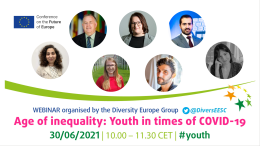
On 30 June, the Diversity Europe Group held a webinar under the banner of the Conference on the Future of Europe on the impact of the COVID-19 crisis on the mental health and employability of young people.
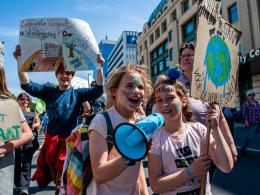
Young people have the right to have a say on matters that concern them. The climate emergency the world is facing today has mobilised millions of young people around the world, many of whom are profoundly affected by the threat it poses for their future. At the same time, it is the young people who have repeatedly demonstrated their energy, creativity and motivation to challenge current unsustainable models and push the decision-makers to adopt ambitious policies. Despite that, a wide gap remains between listening to young people, and actually acting upon their calls and demands.
This public hearing will aim to present and discuss the European Commission’s Strategy on Intergenerational Fariness, a new strategic framework to guarantee that current decisions are made with the future in mind, ensuring a fair balance of benefits and burdens across all generations. The event will gather key institutional actors, civil society organisations, social partners and experts to reflect on the Strategy's priorities and to contribute to the preparation of the EESC Opinion (SOC/868).
The event will be webstreamed (EN, original). No registration is needed and participation is free of charge.
Follow us on X: @EESC_SOC
Ask your questions to the panelists via Sli.do with the event code: #...(code will be added at a later stage)
"Cohesion policy 2028–2034: A new fund, a new framework, a new role for civil society?" brings together EU institutions, social partners and civil society representatives to reflect on the future of cohesion policy in the next Multiannual Financial Framework. The hearing explores proposals for reforming cohesion funding and governance, assesses the implications of the new framework through the National and Regional Partnership Plans and examines how civil society organisations can play a stronger role in the design, implementation and monitoring of cohesion policy. The discussion aims to identify how cohesion policy can continue to deliver territorial, social and economic cohesion while responding to new challenges and transitions facing the European Union.
Public debate in the ECO Section on the Latest twists and turns on the road to the next Multiannual Financial Framework in the framework of the opinion ECO/682 Multiannual financial framework 2028-2034.
The public hearing will examine how national, local and civil society actors will work together to foster collaboration through partnership principle and multi-level governance in order to deliver more inclusive, sustainable, and resilient outcomes across all regions.