
European Economic
and Social Committee
MADE IN THE EU – COMPETITIVE, SOCIAL, SUSTAINABLE
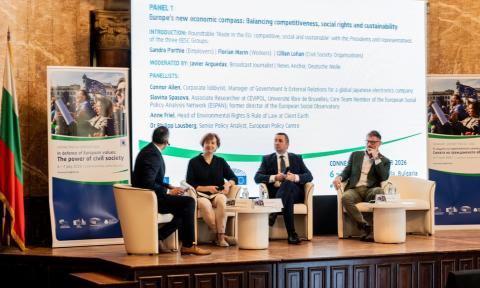
Sandra Parthie and Cillian Lohan, presidents of the EESC Employers’ and Civil Society Organisations’ Groups respectively, and Florian Marin, representing the Workers’ Group, sat down at the Connecting EU 2026 roundtable, Made in the EU: competitive, social and sustainable, to discuss some of the EU’s most pressing priorities. Here are some of the thoughts they shared.
The EU now has an agenda for competitiveness, but before that it had the European Green Deal and Social Europe, pushing for sustainability and better social conditions. How, in your opinion, can we balance the three?
Sandra Parthie, president of the EESC Employers’ Group
Boosting competitiveness, driving the green transition and ensuring strong social standards all depend on investment. However, generating the required capital presents a conundrum that is difficult to resolve. Every euro can only be spent once: should it go to more efficient production, new product development, or workplace safety? This is always a decision that a company or business owner has to make, while also taking into consideration all the compliance costs arising from Europe’s regulatory framework. The problem is that, compared with other regions of the world, operating in Europe has become significantly harder. Unfortunately, businesses and companies are relocating outside the EU, where generating value and maintaining a sustainable operation is easier. The problem is that we have yet to solve this core challenge. How do we get companies to stay in Europe, and ensure that they can invest here and remain profitable? Without profit, there is nothing left to redistribute towards green initiatives, but also to better wages and working conditions. Without making a profit first, there is nothing to redistribute!
To fix this, the EU’s first priority should be to invest in core infrastructure. The limited EU budget available for this should be put into modernising and improving European infrastructure – telecommunications, energy and transport networks. This is the backbone of economic growth. If AI is also to take off in Europe, it needs robust telecommunications networks. Cost-efficient production requires lower energy prices through modernised grids capable of handling renewable energy. Without a solid infrastructure base, energy systems will fail, transport will stall and connectivity will drop. All of this requires public investment in infrastructure. We need to establish the basis from which everything else can develop. Otherwise, we are just going to end up in a situation where the electricity does not work, the trains do not run and, in the end, we cannot talk to each other. That is not what we want.
How can we redefine the concept of competitiveness to ensure that it serves society and the environment, rather than becoming the ultimate goal?
Florian Marin, Workers’ Group
Competitiveness cannot mean inequality, precarious jobs or social dumping. All these harm competitiveness, too. We need four concrete things. First, stop using competitiveness to lower wages. This is a trap that will ultimately hurt democracy, the European Project and competitiveness itself. If you shrink purchasing power, this will impact demand and therefore our economies as a whole. For a long time we have outsourced our growth to other countries, such as the US or China. Trying to compete with China on low wages is a race you cannot win. To be viable, competitiveness must also mean having skills, investing in innovation and creating the conditions for businesses to thrive. This is the path towards competitiveness: not lowering wages but creating a better business environment that can exist sustainably, and that can provide predictable good working conditions and a good quality of life.
Second, we need to see public investment as a driver of growth for the EU. To achieve this, we need to rethink the role of public institutions in investment and involve civil society more closely. Third, I think we need conditionality directing public investment towards the common good, so that the market works for the benefit of society and not the other way round. Fourth, I think it is fundamental to have working social dialogue and collective bargaining. I know that this is a trade union perspective, but once again, we have laws that must be respected. We have the European Minimum Wage Directive – I am thinking for instance of the 80% threshold for collective bargaining coverage. The right measures help companies train, hire and retain talent, which also allows firms to innovate and improve quality and save costs. Of course, we also need the capital market union to ease investment and funding of businesses.
These four things are crucial. We need to integrate them into the future concept of competitiveness. We must work based on collective bargaining, social and fundamental rights, and living, decent wages. This is how we ensure the EU project and democracy survive, how we stop far-right populism, and how we achieve competitiveness in a sustainable manner.
How do we achieve a sustainable economy when resources are scarce and other countries and global powers may be taking a different approach?
Cillian Lohan, president of the EESC Civil Society Organisations’ Group
We already have an overarching framework that we have signed up to and agreed on: the United Nations 2030 Agenda for Sustainable Development with its Sustainable Development Goals. The 17 goals that we set out to achieve include economic growth, infrastructure investment and the social dimension. Importantly, they also include the environmental dimension.
I do not believe that our starting point for building a sustainable economy should be the need for a strong economy – merely to have enough money to finance everything society needs and to protect the environment. Instead, I think we should start from the other side and look at what our needs are as a society. We should look at the need to respect the natural world – from which we obtain all our raw materials – and make this the starting point for designing things, given there are natural limits. We talk about working within planetary boundaries. We see the consequences of starting with the economy: environmental degradation to the point of what we call a triple planetary crisis of pollution, biodiversity loss and climate change. It is extraordinary that we simply accept that this is the world we live in. We have destroyed habitats and altered our climate to the point where parts of the Earth could potentially become uninhabitable. If we continue on this trajectory, we are going to have a huge migration problem from populated areas that will no longer be habitable.
I think what we actually need is a shift in how we approach the problem in the first place. We must find a way to deliver on those goals from that different perspective.
I have never subscribed to the idea that the best reason for doing something is that everybody else is doing it. In fact, I think it is better to do things a little differently from everybody else. Sometimes that can be very successful and sometimes disastrous. But in this case, I think we already have a very strong basis for sustainability. When you travel around the world, you see that the rest of the world looks to the EU as a leader in sustainability. I think that really sets us apart. We have this paranoia that the world sees us as great regulators and rule-makers. We have bought into that narrative, and now I feel that we are obsessed with deregulating and getting rid of rules because we want to show other people: ‘Oh no, that is not what we are about. Look at us, we are free and carefree’. But rules and regulations are not necessarily bad if they deliver the right outcomes. Some of our rules and regulations are not delivering the right outcomes, and they need to be adapted and changed. But we are already leaders in the field of sustainability, and I think we should embrace that.