A Sustainable Recovery for the Future of Europe's Citizens
-
Location
Brussels
Belgium
Following the outbreak of the COVID-19 pandemic, 2020 has proved to be an endurance test for human and social rights, democratic values, the rule of law and economic resilience in the EU. While navigating stormy waters, organised civil society is playing a key role in coping with the countless pandemic-related challenges at European, national, regional and local level.
In response to the Commission Communication Stepping up Europe's 2030 climate ambition, the European Economic and Social Committee (EESC) reaffirms that the Commission's decision to raise the EU's ambition on reducing greenhouse gas (GHG) emissions to at least 55% below 1990 levels by 2030 is the right one. However, in its opinion Stepping up Europe's climate ambition, the EESC insists on increasing efforts to achieve the intermediate targets, speeding up the process and placing the European citizens at the centre of climate action. Failing this, the EU will be at risk of missing its climate-neutral goal by 2050.
To discuss ways to accelerate action on the UN Sustainable Development Goals (SDGs) for a sustainable recovery, the EESC Section for Agriculture, Rural Development and the Environment held a debate on 15 December in connection with the Europe Sustainable Development Report 2020, published on 8 December. The report is a joint initiative by the Sustainable Development Solutions Network (SDSN) and the Institute for European Environmental Policy (IEEP), in collaboration with the EESC.
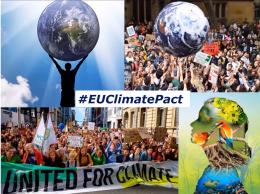
On one of the most important weeks of the year for climate action, with the fifth anniversary of the Paris Agreement, the European Council on Climate, and the launching on 16 December of the Climate Pact by the European Commission, the European Economic and Social Committee (EESC) calls upon ownership and empowerment of civil society as a precondition to success.
Lutz Ribbe, newly elected president of the Sustainable Development Observatory for the term 2020-2023, shares his views on Sustainable Development, the challenges ahead and the priorities of his mandate.
The presentation of key findings and policy recommendations of the Europe Sustainable Development Report 2020 by the authors will be followed by a conversation with various stakeholders and a discussion with the NAT Section Members.
A short statement by the newly appointed NAT section president (Mr Peter SCHMIDT), highlighting the priorities for his mandate and sharing his vision for a sustainable recovery, post Covid-19.
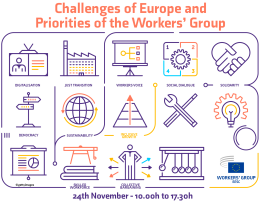
The Workers' Group is organising an extraordinary meeting on the current challenges for Europe and the priorities of the Workers' Group in this framework.
On 9 September 2020, the European Commission adopted its first annual Strategic Foresight Report, presenting Commission’s strategy to integrate strategic foresight into EU policy-making. Strategic foresight aims to identify emerging challenges and opportunities to better steer the European Union's strategic choices and to inform major policy initiatives. It will support the Commission in designing future-proof policies and legislation that serves both the current needs and longer-term aspirations of European citizens.