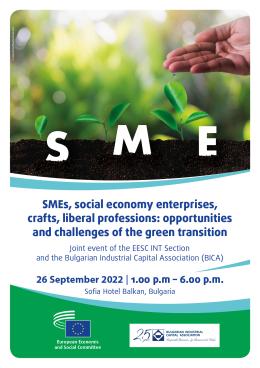
This joint high-level event focused on topical questions such as the challenges faced by Micro, Small, Medium Enterprises (MSMEs) to successfully adjust to the climate neutral and digitalised world. It has also analysed the possible avenues to help MSMEs to be well informed and prepared to grasp the opportunities of the transition to climate neutrality, coupling it with the possibilities offered by the digitalisation and hedging the current geopolitical risks.
The EU as a driver of shared prosperity – civil society for an economy that works for people & the planet
-
Location
HYBRID EVENT • EESC
Brussels
Belgium
While Europe and its societies are still in the grip of the COVID-19 pandemic and with the Conference on the Future of Europe in its closing stages, the EESC will be holding its annual Civil Society Days in March 2022.
Which contribution to the Conference on the Future of Europe?
Event type
Debate
Location
European Parliament, Room N.1.4
67070 Strasbourg
France
The Conference on the Future of Europe (CoFoE) cannot ignore the model of economic governance created by the social economy. Its existence is based on historical foundations anchored in many European countries where it is both a social and an entrepreneurial dynamic. In some other countries, it is the subject of renewed interest. The European Commission is devoting an action plan to it to unleash its full potential. The European Parliament has already dedicated many reports to it, but today it is necessary to take further steps. The social economy must be promoted in the work of the CoFoE, for its values and democratic principles, for its entrepreneurial diversity and for its role in enhancing active citizenship.
A Sustainable Recovery for the Future of Europe's Citizens
-
Location
Brussels
Belgium
Following the outbreak of the COVID-19 pandemic, 2020 has proved to be an endurance test for human and social rights, democratic values, the rule of law and economic resilience in the EU. While navigating stormy waters, organised civil society is playing a key role in coping with the countless pandemic-related challenges at European, national, regional and local level.
On 17 February 2021, the European Economic and Social Committee has organised a hearing in the framework of its exploratory opinion requested by the Portuguese presidency on The role of social economy in the creation of jobs and in the implementation of the European Pillar of Social Rights.
Europe is facing a pivotal moment. Social and economic inequalities, rapid technological change, anti-democratic forces and geopolitical instability are straining the foundations of the European project.
With democracy and civic space under mounting pressure, civil society organisations, human rights defenders and free media face growing constraints - from restrictive laws and disinformation campaigns to underfunding and public distrust. Deepening polarisation and eroding trust in institutions further undermine Europe’s democratic model.
The present catalogue of good practices is a collection of numerous successful initiatives implemented by civil society organisations in Europe in response to the outbreak of the COVID-19 pandemic. The information set out in this catalogue was brought together in the framework of the study "The response of civil society organisations to face the COVID-19 pandemic and the consequent restrictive measures adopted in Europe", commissioned by the European Economic and Social Committee at the request of the Diversity Europe Group.
As the COVID-19 pandemic hits societies and economies, bringing a global and unprecedented public health and social crisis, civil society organisations (CSOs) are responding by providing frontline help and defending the rights of people across the world. At the same time, CSOs have faced themselves profound impacts that may harm their capacities to continue playing their central roles in delivering services, advocating for rights and protecting the most fragile, while safeguarding participatory democracy and civic debate in the near future.
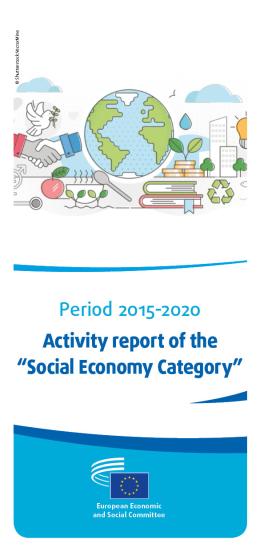
During the years 2015-20, the the Social Economy Category has striven to promote and defend the interests of the social economy to the widest possible audience. It has sought to gain recognition for the substantial contribution of the sector to Europe’s socio-economic development and to the success of the European integration process.
The general objective of the Report is to study the recent evolution of the social economy in the European Union. It focuses on three areas: firstly, the social economy and the emergent concepts/movements related to it, secondly, the public policies adopted in both the EU and the member states in recent years to enhance the social economy sector and thirdly, measuring the weight of the social economy in each EU member country.