The Commission proposed in March 2021 new pay transparency measures, such as pay information for job seekers, a right to know the pay levels for workers doing the same work, as well as gender pay gap reporting obligations for big companies. The proposal aims to strengthen the tools for workers to claim their rights and facilitate access to justice. Employers will not be allowed to ask job seekers for their pay history and they will have to provide pay related anonymised data upon employee request. Employees will also have the right to compensation for discrimination in pay.
To improve the implementation of the EU Charter of Fundamental Rights it is necessary to empower civil society organisations, rights defenders and justice practitioners, and strengthen people’s awareness of their rights under the Charter. CSOs and social partners are operating at grassroots levels and can help spread awareness and foster implementation. Moreover, the social partners have a special role in contributing to the implementation and defence of socio-economic fundamental rights.
In the context of the opinion on a "Union of equality: EU anti-racism action plan 2020-2025", the European Economic and Social Committee is organising a virtual public hearing on 18 March. The aim of the hearing is to gather the points of view of international organisations, European platforms for human rights and the fight against racism, and representatives of European institutions, on key measures of the action plan, and to discuss how to tackle racism and racial discrimination more effectively in the EU.
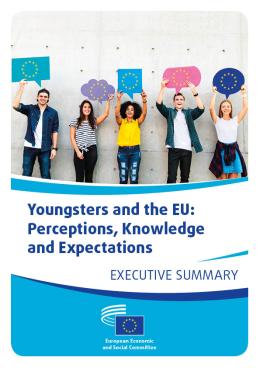
This study is conducted to better understand youngsters' relationship with the EU. The study examines 14- to 18-year-old youngsters' perceptions, and knowledge of the EU as well as their expectations towards the EU, and openness to the European diversity.
This study is conducted to better understand youngsters' relationship with the EU. The study examines 14- to 18-year-old youngsters' perceptions, and knowledge of the EU as well as their expectations towards the EU, and openness to the European diversity.
This compendium brings together all the opinions and reports which, over the last thirty years, have enabled the EESC and civil society organisations to strengthen participatory democracy and become an indispensable part of the European decision-making process.
Through this opinion, requested by the German Presidency of the Council, the EESC recognises the essential role of smoothly functioning public services in defending core EU values. The opinion highlights their particular role in times of crisis, like COVID-19, which calls for the maximum human and financial support. The EESC proposes common European principles to support the role of public services in defence of democracy. They include the principles of neutrality, legality, proportionality, equal treatment and transparency; the right to good administration; independent oversight; the protection of public services staff against decisions breaching the rule of law; accessibility; interoperability; and the respect of the rule of law including when receiving EU funds.
Download format:
Download — EESRK nuomonė: Principles for public services (i.e. public services for citizens, public administration) that contribute directly to the stability of the free democratic basic order (democracy and the rule of law) in EU countries (Exploratory opinion at the request of…
The EESC describes integration as a dynamic process, involving both migrants and the receiving society. It believes that migration challenges should be addressed in a holistic manner. Gender equality should become one of the key pillars in integration. Migrant families and parents should be involved in the local and school community as from the early stages of reception. On language training, the EESC believes that this should foresee cultural exploration and involvement in the community and society, as well as guidance and information to migrants on the advantages and the aims of language training. In view of the disparities that exist in Member States with regard to language teaching, the EESC calls for common EU guidelines for language training, which can help ensure a unified and holistic approach.
Download format:
Download — EESRK nuomonė: Integration of women, mothers and families with a migrant background in the EU Member States and target language levels for integration (Exploratory opinion at the request of the German presidency)
In this own-initiative opinion the EESC calls on the European institutions to promote a positive image of CSOs, preserve their independence and strengthen their capacity for action.
Beside a detailed diagnosis of the situation and role of civil society organisations, the EESC presents 26 recommendations for better civil dialogue and access to resources, including ideas for the post-2020 Multiannual Financial Framework.
The EESC finds that financing of CSOs is essential for participatory democracy and that the article 11 of the TEU on structured dialogue with civil society must be properly implemented. It calls also for the establishment of an EU Ombudsman on civic space freedoms and of a European fund for democracy, human rights and values within the EU.
Download format:
Download — EESRK nuomonė: Financing of CSOs by the EU (own-initiative opinion)