The EESC is calling on policy-makers to implement a comprehensive and holistic strategy for balanced, cohesive, equitable and sustainable rural and urban development. This will involve harnessing the role of local communities, boosting traditional industries and creating new economic activities and job opportunities in rural areas, while fostering synergies with urban areas. The opinion adopted on this topic will contribute to the implementation of the Commission's long-term vision for the EU's rural areas put forward last June.
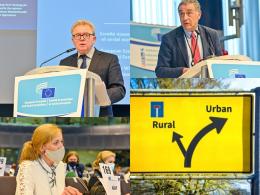
An interview with Piroska Kállay, a member of the European Economic and Social Committee (EESC) from the Workers' Group, representing Medosz, the Trade Union of Agriculture, Forestry, Food and Water Supply Workers in Hungary. She is currently one of the members of the NAT section and her work focuses in particular on environmental protection and the territorial development of rural areas.
The NAT section invited the two winners of the COPA COGECA 2021 Innovation Award for Women Farmers to join its Section meeting of 15 April 2021 to bring practical and innovative ideas in their debates.
Europe's rural and urban territories are not developing evenly. It is critical to foster policies that curb this trend, ensure a fair and sustainable transition to a wellbeing economy in all areas and promote population rebalancing.
An interview with Josep Puxeu Rocamora, member of the European Economic and Social Committee (EESC) from the Employers' Group, representing the Spanish Food and Drink Industry Federation (FIAB). He is currently one of the Vice Presidents of the NAT Bureau and his work focuses in particular on balanced territorial development.
rue Belliard 101, Jacques Delors building, room JDE 63, 9:30-11:00
Brussels
Belgium
EESC, room JDE 63, 9:30-11:00
The policy debate brings together stakeholders to assess how National and Regional and Partnership Plans will work in practice. In a workshop setting connected to the European Economic and Social Committee, participants from civil society, social partners and institutions will exchange perspectives on transparency, inclusiveness and impact. The discussion aims to highlight gaps, share best practices and strengthen the role of organised civil society in shaping and monitoring the implementation of NRPPs in the EU.
Public debate in the ECO Section on the The Multiannual Financial Framework after 2027 - Assessing progress and outstanding challenges. The event will take stock of developments in the negotiations since the Commission presented their proposals for the next Multiannual Financial Framework and discuss outstanding challenges.
The debate of the EESC on “Strong regions for a safe Europe:Resilience and growth of EU Eastern border regions” will focus on the strategic importance of strengthening resilience and fostering sustainable growth in the European Union’s eastern border regions.
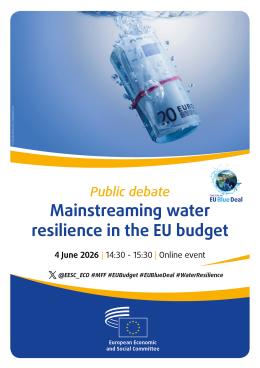
Mainstreaming Water Resilience in the EU Budget is a timely discussion on securing Europe’s water future. Discover how smarter EU investments can strengthen water resilience, sustainability, and preparedness, and how we should shape tomorrow’s funding priorities across programmes in the context of the EU´s next Multiannual Financial Framework.