
European Economic
and Social Committee
Insufficient enforcement of common EU rules, threats to consumer confidence, excessive complexity for SMEs and a loss of competitiveness in the digital sector are among the greatest challenges facing the single market
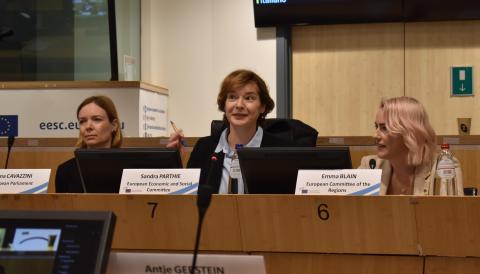
On 3 June, the European Economic and Social Committee (EESC), the Committee of the Regions (CoR) and the European Parliament jointly organised a conference entitled ‘One Europe, One Market: From Strategy to Delivery’. The event focused on how to turn the EU’s new One Europe, One Market roadmap – launched by EU leaders in April – into concrete results for citizens and businesses.
The conference brought together EESC and CoR members, MEPs, civil society stakeholders and experts to discuss the future of Europe’s single market, which, despite being one of the pillars of European integration, remains heavily fragmented, hampering Europe’s competitiveness and economic growth.
‘The single market is under pressure. We at the EESC hear the concerns directly from businesses, workers and civil society – the very people who should benefit fully from the single market, but still do not,’ said Antje Gerstein, President of the EESC’s Section for the Single Market, Production and Consumption.
‘There is no magic law that you can implement to create the single market. It is much more difficult and much more nitty-gritty. We have to take concrete examples of where things are not functioning,’ said Anna Cavazzini, chair of the Parliament’s IMCO Committee.
‘In the context of the next multiannual financial framework and future EU funding programmes, it should be recognised that cohesion policy and the single market are not competing priorities; rather, they are mutually reinforcing. One cannot succeed sustainably without the other,’ said Emma Blain, Dublin City Councillor and CoR member.
The panel on ‘Product safety and compliance: enhancing market surveillance for better products and consumer protection’ focused on unsafe or non-compliant products entering the EU market through online marketplaces, many originating from China. Panellists stressed that the current liability regime does not reflect digital commerce, undermining consumer confidence and causing significant financial losses.
The discussion on ‘Public procurement, sustainability and circular economy goals’ highlighted the need for simpler, faster and more accessible procurement rules, particularly for SMEs. Speakers noted that complex, price-driven procedures often deter small operators from bidding and can exclude citizen-led projects.
During the panel on ‘Building a smarter and simpler single market for the digital era’, speakers underlined the need for predictable rules, interoperable systems and practical support for SMEs. Businesses still face barriers linked to incompatible national systems, fragmented data rules and insufficient interoperability, while the question of more or less regulation remained open. (ll)