The Single Digital Booking and Ticketing Regulation (SDBTR) aims to make rail travel more accessible by allowing passengers to book multi-operator journeys through a single digital platform. It focuses specifically on expanding digital access to rail tickets and fares and reduces ticketing fragmentation while ensuring passengers retain their rights throughout the entire journey.
Download format:
Download — Mišljenje EGSO-a: Single Digital Booking and Ticketing Regulation (SDBTR)
The EESC calls for the establishment of a dedicated Union strategy for islands (Islands Pact), supported by a specific legislative framework (Islands Act). That framework should be accompanied by a formal strategy and provide for the effective implementation of an ‘insularity clause’, with a view to systematically integrating the specific needs and constraints of islands into Union policies on cohesion, transport, energy, state aid, the environment and maritime affairs.
This study examines how social partners and civil society organisations in six Member States — Italy, Austria, Hungary, Poland, Portugal and Sweden — view the effectiveness of current policies in raising employment levels and increasing adult participation in training. It also puts forward recommendations for improving policy outcomes.
The public hearing will examine how national, local and civil society actors will work together to foster collaboration through partnership principle and multi-level governance in order to deliver more inclusive, sustainable, and resilient outcomes across all regions.
Europski gospodarski i socijalni odbor (EGSO) usvojio je na rujanskom plenarnom zasjedanju mišljenje o novom paktu za Mediteran, mjesec dana prije nego što ga Europska komisija službeno objavi. Odbor poziva na pristup odozdo prema gore kako bi se osiguralo da pakt ima izravan i pozitivan učinak na sve ljude, posebno na mlade.
Download — Mišljenje EGSO-a: Establishing the European Fund for Regional Development including for European Territorial Cooperation (Interreg) and the Cohesion Fund
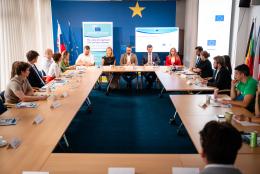
Introduced by the European Economic and Social Committee (EESC) in 2024, the Youth Test is now being recognised as a pioneering method for integrating youth voices into policy-making. A recent roundtable in Bratislava brought together young leaders, policymakers and civil society to examine how the Youth Test can be meaningfully integrated into national decision-making processes.
In this opinion, the European Economic and Social Committee (EESC) outlines its recommendations regarding the proposed regulation for the Erasmus+ program spanning 2028 to 2034. The recommendations include the following: • Establish a clear distinction between Youth, Education and Training, and Sport. • Ensure transparent budget allocation between Youth and Vocational Education and Training (VET). • Implement measures to safeguard youth participation and support the Solidarity Corps. • Develop strategies to enhance inclusion across the program. • Strengthen initiatives to improve skills, thereby facilitating better outcomes in the labor market.