European Economic
and Social Committee
European Economic
and Social Committee
The European Economic and Social Committee (EESC) is the voice of organised civil society in Europe.
Find out more about its role and structure at http://www.eesc.europa.eu/en/about
The EESC issues between 160 and 190 opinions, evaluation and information reports a year.
It also organises several annual initiatives and events with a focus on civil society and citizens’ participation such as the Civil Society Prize, the Civil Society Days, the Your Europe, Your Say youth plenary and the ECI Day.
Find the latest EESC opinions and publications at http://www.eesc.europa.eu/en/our-work/opinions-information-reports/opinions and http://www.eesc.europa.eu/en/our-work/publications-other-work/publications respectively.
The EESC is active in a wide range of areas, from social affairs to economy, energy and sustainability.
Learn more about our policy areas and policy highlights at http://www.eesc.europa.eu/en/policies
The EESC holds nine plenary sessions per year. It also organises many conferences, public hearings and high-level debates related to its work.
Find out more about our upcoming events at http://www.eesc.europa.eu/en/agenda/our-events/upcoming-events
Here you can find news and information about the EESC'swork, including its social media accounts, the EESC Info newsletter, photo galleries and videos.
Read the latest EESC news http://www.eesc.europa.eu/en/news-media/news and press releases http://www.eesc.europa.eu/en/news-media/press-releases
The EESC brings together representatives from all areas of organised civil society, who give their independent advice on EU policies and legislation. The EESC's326 Members are organised into three groups: Employers, Workers and Various Interests.
Find out more about our Members and groups at http://www.eesc.europa.eu/en/members-groups
The EESC has six sections, specialising in concrete topics of relevance to the citizens of the European Union, ranging from social to economic affairs, energy, environment, external relations or the internal market.
Find out more at http://www.eesc.europa.eu/en/sections-other-bodies
Economy and finance, digitalisation, competitiveness and business, and trade. These are the four areas where the Spanish Presidency of the Council of the European Union made progress from July to December 2023.
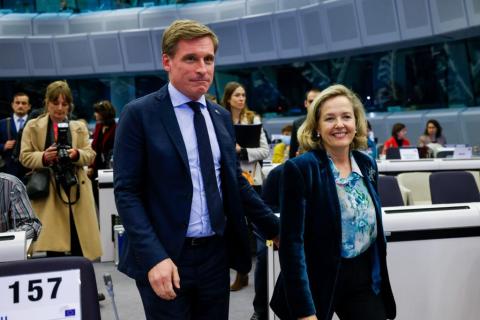
Speaking at the December plenary session, Spain's first deputy prime minister and minister for economy and digitalisation, Nadia Calviño, summarised the conclusions of the rotating EU Presidency, mentioning, among other things, the deepening of economic and monetary union, instant payments in banking, the reform of the electricity market and the signing of an advanced trade agreement with Chile.
Ms Calviño, who is expected to take up office as the next president of the European Investment Bank (EIB) on 1 January 2024, also highlighted the items the European Union will need to put on the agenda soon, especially in view of the upcoming European elections. "The world is undergoing a massive change and the tectonic plates created after the Second World War are shifting," she said. "We need to ensure that the EU continues to lead the most important debates in the world, tackles the main challenges and protects its European values in this new world."
Referring to the busy semester that was about to end, she added that "cooperation with other European institutions and, in particular the EESC, was instrumental in its success. My presence shows the strong commitment of the Spanish government to the social partners, social dialogue and civil society. We try to listen carefully and integrate the opinion of civil society into our work." (mp)