European Economic
and Social Committee
European Economic
and Social Committee
The European Economic and Social Committee (EESC) is the voice of organised civil society in Europe.
Find out more about its role and structure at http://www.eesc.europa.eu/en/about
The EESC issues between 160 and 190 opinions, evaluation and information reports a year.
It also organises several annual initiatives and events with a focus on civil society and citizens’ participation such as the Civil Society Prize, the Civil Society Days, the Your Europe, Your Say youth plenary and the ECI Day.
Find the latest EESC opinions and publications at http://www.eesc.europa.eu/en/our-work/opinions-information-reports/opinions and http://www.eesc.europa.eu/en/our-work/publications-other-work/publications respectively.
The EESC is active in a wide range of areas, from social affairs to economy, energy and sustainability.
Learn more about our policy areas and policy highlights at http://www.eesc.europa.eu/en/policies
The EESC holds nine plenary sessions per year. It also organises many conferences, public hearings and high-level debates related to its work.
Find out more about our upcoming events at http://www.eesc.europa.eu/en/agenda/our-events/upcoming-events
Here you can find news and information about the EESC'swork, including its social media accounts, the EESC Info newsletter, photo galleries and videos.
Read the latest EESC news http://www.eesc.europa.eu/en/news-media/news and press releases http://www.eesc.europa.eu/en/news-media/press-releases
The EESC brings together representatives from all areas of organised civil society, who give their independent advice on EU policies and legislation. The EESC's326 Members are organised into three groups: Employers, Workers and Various Interests.
Find out more about our Members and groups at http://www.eesc.europa.eu/en/members-groups
The EESC has six sections, specialising in concrete topics of relevance to the citizens of the European Union, ranging from social to economic affairs, energy, environment, external relations or the internal market.
Find out more at http://www.eesc.europa.eu/en/sections-other-bodies
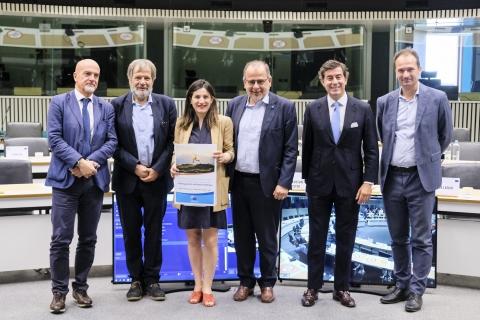
During its annual conference in June, the European Semester Group (ESG) renewed its call for civil society participation and proposed a permanent and common investment financing mechanism to enhance crisis preparedness and response capacity.
The conference followed on from the recent Committee resolution to discuss the reform of the European Semester, which will be overseeing the implementation of the national recovery and resilience plans (NRRPs). "With the new challenges facing the EU, the European Semester needs to be updated, strengthened, and opened up to European organised civil society", explained ESG vice-president Gonçalo Lobo Xavier.
Opening the conference, EESC president Christa Schweng reaffirmed that that ''civil society has a crucial role for the Europe of tomorrow'', while Elisa Ferreira, commissioner for cohesion and reforms, said: "as we think about future crises, we need to think in terms not of one master tool, but of many tools and a well-stocked toolbox. We need diversification."
The EU will need massive investments in the years to come. The panellists discussed whether these recovery plans should be made structural and permanent to ensure common investment in key areas. "Europe needs energy independence", stated Javier Doz Orrit, president of the European Semester Group, while president of the Section for Economic and Monetary Affairs (ECO), Stefano Palmieri, insisted on the need to "ensure a structural transformation of the system."
Luca Jahier, vice-president of the European Semester Group, closed the conference by acknowledging the importance of the RRF and the NRRPs. "With these tools, we have done more in these last two years than in the last 20 years", he said. "We now need to ensure the participation of organised civil society, invest more and accelerate the transition." (tk)