19 October 2023 | 09:30 - 13:00 | EESC | Room JDE62/Interactio | Rue Belliard 99, 1040
Brussels
Belgium
How is the EU measuring up when it comes to integrating newcomers to our societies? This event, organised by the EESC's permanent group on immigration and integration, aims to examine the success and lessons learned of integration and inclusion as an EU policy as well as a reality facing many cities and regions in the EU.
Distinguished panels from EU policy, social partners, cities and think tanks will help answer this question.
At a time of increasing geopolitical rivalry and the steady erosion of the multilateral rules-based trading system, EU’s competitiveness has taken centre stage in the EU agenda.
As in previous years, the European Economic and Social Committee, as the body representing organised civil society in the EU, will be following the High Level Political Forum on Sustainable Development (HLPF), which will take place in New York from Monday 10 July to Wednesday 19 July 2023.
The European Economic and Social Committee (EESC) organises regular consultations of the European Union‑Africa Economic and Social Stakeholders' Network, which gathers representatives of organised civil society (employers and chambers of commerce, employees and trade unions, cooperatives, farmers' organisations, consumers' organisations, NGOs, etc.) from both continents.
The 8th meeting of the EU-Africa Economic and Social Stakeholders' Network will take place in Brussels, Belgium, on 28-29 June 2023, at EESC premises, with the participation of African Union Economic, Social and Cultural Council (AU ECOSOCC).
Employer representatives from 27 countries are in Luleå to discuss the conditions for the green transition, sustainable growth and the EU's new competitiveness agenda on 19–20 June.
EESC, Van Maerlant Building, Rue Van Maerlant 2, room VMA 3
Brussels
Belgium
The Day of the Liberal Professions will take place on 2 May 2023 at the EESC in Brussels. This annual event brings together key players from Europe's liberal professions, as well as key policy makers from the European Commission, European Parliament and Member States.
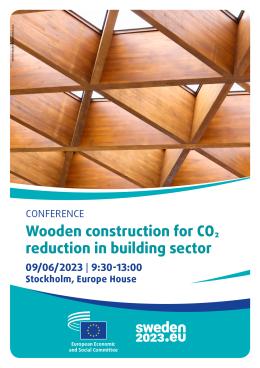
The European Economic and Social Committee (EESC) has looked into the advantages of modern industrial wooden construction at the request of the Swedish Presidency of the Council of the European Union. The EESC adopted an exploratory opinion focusing on how EU proposals such as sustainable carbon cycles, the bioeconomy strategy and the New European Bauhaus can be used to drastically reduce the huge amounts of construction-related CO2 emissions, store CO2 and make construction more efficient.