
European Economic
and Social Committee
EESC President
EESC marks first EU Water Resilience Forum as a turning point for Europe’s water future
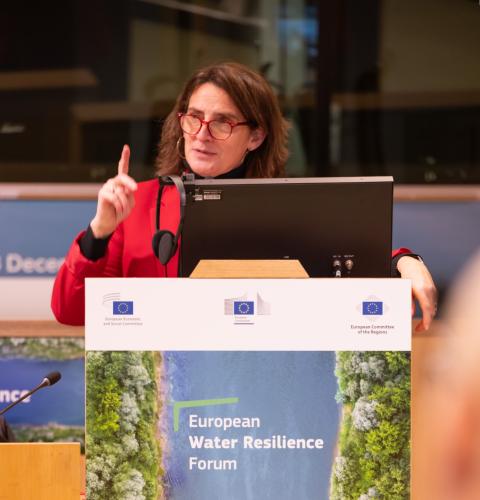
The first EU Water Resilience Forum, co-organised by the European Economic and Social Committee (EESC), the Committee of the Regions, and the European Commission, brought together people working on Europe’s water challenges to share ideas and solutions to protect water for families, communities and future generations. The Forum also launched the Water Resilience Stakeholder Platform to turn these ideas into action.
A collective effort for water resilience
Opening the Forum, Commissioner for Environment, Water Resilience and a Competitive Circular Economy Jessika Roswall spoke about the urgency of the moment. ‘Water is no longer an infinite resource, and we are determined to protect it. We must recognise the true value of water and its role for a resilient and strategic independence. This Forum provides a space to share solutions, explore opportunities and act with hope, creativity and urgency’.
Executive Vice-President for a Clean, Just and Competitive Transition, Teresa Ribera, stressed that water resilience is now at the heart of Europe’s political agenda. For many Europeans, climate change is experienced through water. ‘Water connects everything we care about, from climate and industrial competitiveness to food security and fairness. Water is life, a shared responsibility and the foundation of a Europe that is competitive, fair and secure’, she said, pledging to integrate water resilience into the fairness agenda, industrial strategy and climate policy.
The EESC and the EU Blue Deal
For the EESC, the Forum was also a moment to reaffirm its long-standing call for stronger EU action through the EU Blue Deal, the Committee’s cross-sectoral water strategy. The initiative has helped raise water to the top of the EU agenda, contributing directly to the creation of Commissioner Roswall’s dedicated water portfolio.
First launched in 2023, the EU Blue Deal Declaration has now been updated with ten new concrete actions, from the main recommendations of seven opinions adopted by the EESC since the first edition, bringing the total to 31 measures for a comprehensive, cross-sectoral water strategy. A key proposal is the EU Water Test, a systematic check of how new EU laws affect water resources, efficiency and pollution.
EESC President Séamus Boland explained why the Blue Deal is about more than policy: ‘our Blue Deal puts people and communities at the centre of EU water policy. Water scarcity and pollution affect us all, but the burden falls hardest on those who have the least,’, he said. ‘Fair access to water is a matter of justice. Europe’s water future is ultimately about protecting people, livelihoods and future generations. Today’s discussions show that when institutions, businesses, civil society and citizens come together, real progress is possible’.
The local perspective
Kata Tüttő, President of the European Committee of the Regions, highlighted the vital role of cities and regions in Europe’s water strategy. ‘Water is everywhere in our lives: to drink, to grow food, to secure jobs, for medicine, for energy, even for data storage’, she said. ‘We are the local level, and we feel the anxiety of water every day. The Danube River flows through 10 countries and four capital cities. If I pollute my water in Budapest, there will be problems in Belgrade and Vienna’. She stressed that cooperation, careful planning and long-term policies are essential to manage growing water challenges and prepare for an unpredictable future.
Key outcomes of the Forum
The Forum focused on three main goals: restoring the water cycle, building a water-smart economy, and making sure everyone has access to clean, affordable water. Participants shared real-world solutions from cities, industries and communities, exploring better water management, efficiency, digital tools, funding and skills. They also emphasised the human side of water, touching upon vulnerable communities, health, affordability and citizen awareness.
The Forum concluded with a shared commitment to turn political priorities into concrete action, support new ideas, invest where it matters and strengthen cooperation across Europe to secure water resilience by 2050.
Working together through the Water Resilience Stakeholder Platform
A key announcement of the day was the launch of the Water Resilience Stakeholder Platform. The platform will bring together experts, local authorities, civil society and businesses to help implement Europe’s water strategy. The EESC welcomed the initiative and confirmed its readiness to actively contribute.
‘As the house of Europe’s civil society, the EESC is uniquely placed to connect policymakers with workers, businesses, farmers, consumers and local communities’, said Mr. Boland. ‘This platform is a chance to turn ideas into practical, people-centred solutions and ensure that no one is left behind’.
Work organisation
Contact
Séamus BOLAND
European Economic and Social Committee
rue Belliard/Belliardstraat 99-101 1040 Brussels Belgium
Tel (secretariat): +32 (0)2 546 97 25 - Email (secretariat)
Media Contact
For press and media inquiries, please contact the President's Spokesperson