
European Economic
and Social Committee
Who will stay on board? European elections debate with focus on the labour market
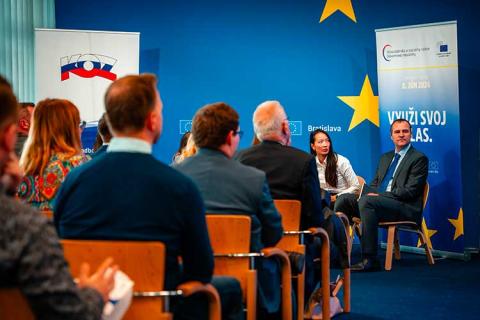
The future of the labour market in Slovakia
We are in the top fourth of the richest countries in the world, which something we sometimes forget. However, Slovakia will have to respond flexibly to evolving labour market conditions, demographic developments and trends to stay competitive.
The digital transformation across the EU creates new jobs, especially in the technology sector, but it also requires upskilling and reskilling of the workforce to meet new challenges. It is the lack of skilled workforce in Slovakia that is becoming a stumbling block for employers and potential foreign investors.
These issues were discussed by the guests of the discussion entitled "What is the future of the labour market in Slovakia? How does EU membership and European legislation affect the Slovak labour market?". The event took place at the House of the European Union in Bratislava on 29 April.
The debate was organised by the European Economic and Social Committee (EESC) in cooperation with the Confederation of Slovak Trade Unions (KOZ SR), as part of a series of events focused on the upcoming EP elections. EESC member Miroslav Hajnoš informed attendees about EESC activities and the Trade Union Manifesto for the upcoming European Parliament elections.
The discussion was opened by the Commissioner for International Partnerships, Jutta Urpilainen, who began by congratulating Slovaks on the 20th anniversary of their accession to the EU.
"Digitalisation has changed us – not only our lives, but also how and with what we work. Demographic change and globalisation are changing our economy. Climate change is taking its toll. After the covid-19 pandemic, we see that the world has no borders. More than ever, we need to work together. This is an election year, so please let’s reaffirm our common commitment to a united, prosperous, more connected Europe. Only together can we fight terrorism, climate change, rising inequalities and illegal migration," said the Commissioner.
People as a barrier
Slovakia has made significant economic progress since joining the EU. New foreign investments flowed to our market and we became an automotive superpower. One of the main problems expressed by the debate participants was the lack of skilled workforce.
Currently, there are approximately 86 000 vacancies on the market, statistically we are approaching 25-year highs. On the other hand, we have more than 160 000 job seekers. Many employers and investors feel this is a barrier to doing business. According to an economist, this problem will lead to stagnation in the country.
"The statistics clearly show that when you don't have enough employees you have to offer higher wages and the wage dynamic in Slovakia increased in the second decade since EU accession. At the same time, workers are leaving Slovakia and there is only a limited inflow of foreign workers into our market," said Miroslav Štefánik, director of the Institute of Economics of the Slovak Academy of Sciences.
According to statistics, more than 350 000 Slovaks live and work abroad and these are mostly skilled workers.
"We must also focus on systematically creating jobs for people who have left and want to return. But this is not happening. Look at the state administration, look at the business environment," said Vladimír Šucha, head of the Representation of the European Commission in Slovakia.
Legislation is not a silver bullet
According to experts, the creation of the Alliance of Sectoral Councils, which responds to the needs of the labour market, is a good signal. The President of KOZ SR Monika Uhlerová also considers the act on lifelong learning, which is currently in the inter-ministerial comment procedure, to be a positive development:
"The act is finally on the table, although I think it is rather late. It was expected a couple of years ago. Of course, the jobs problem is not just a matter of legislation, that will not solve everything."
Vladimír Šucha added that education is a challenge across the EU:
"I call it an educational paradox. Our survey showed that 78% of entrepreneurs cannot find skilled labour and at the same time 71% of people think they are skilled enough. So people do not feel the need to learn. The problem is more complex; it is not just supply, but also people's motivation. We will have to look for resources there."
According to Monika Uhlerová, Slovakia has for a long time focused on the quantity of jobs and forgetting the quality.
"We have poor quality jobs. Even the research that KOZ SR conducted with experts from the labour market found that we have the lowest quality jobs in the EU. This is also a problem in our country, which translates into the quality of the labour market."
The challenge for us in the coming years will also be to deal with the issue of precarious jobs. That is to say, temporary, risky and substandard contracts, which can also be described as work with reduced labour protection and for lower wages.
See also article at: https://epracaonline.sk/aka-je-buducnost-trhu-prace-na-slovensku/