572nd Plenary session, with the following guests: Ivan Bartoš, Deputy Prime Minister of the Czech Republic, Margaritis Schinas, EU VP, David Clarinval, Deputy Prime Minister (Belgium), Isabelle Schömann (ETUC) and Véronique Willems,(SMEunited), Guy Rider(ILO).
During this meeting of the EU DAG for Vietnam, participants discussed the situation on the ground and labour law reform in Vietnam in the light of the ratification of the ILO Conventions, in presence of a representative from the Institute of Southeast Asian Studies.
It was likewise an excellent opportunity for the EU DAG to receive a timely update from DG Trade on TSD-implementation and related issues, in particular the implementation of the labour rights roadmap, as well as information on the space for civil society in Vietnam.
The members of the EU DAG also further exchanged views on the experiences of their organisations with regard to TSD- issues in Vietnam.
Finally the drafting of a desk study on supply chains was discussed.
The Western Balkans Civil Society High-Level Conference brought together EESC members, civil society representatives from the countries of the Western Balkans, as well as Czech officials and members of organised civil society. The conference complemented the work the EESC has already been undertaking by organising the Western Balkans Civil Society Forum every two years since 2006.
The main topics on the agenda were:
European path for the Western Balkans: Roadmap towards clear accession perspective and the role of young people
Contribution of civil society to youth policy in the Western Balkans: challenges and opportunities in building a better future for the Western Balkans and amplifying the voice of young people from the Western Balkans
Human capital development in the Western Balkans
Youth employment challenges in the Western Balkans
Young people in the Western Balkans as an important force in regional cooperation and promoting European integration
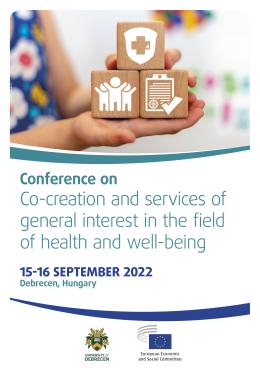
The European Economic and Social Committee and the University of Debrecen, Hungary orgnaised on 15-16 September, 2022 a high-level, prestigious international scientific-professional conference on Co-creation and services of general interest in the field of health and well-being in Debrecen, Hungary.
On 15 September 2022, the EESC's Labour Market Observatory will hold a remote public hearing on The labour market in rural areas.
The EU's rural areas are home to 137 million people representing almost 30% of its population and over 80% of its territory. The hearing will examine labour market developments and trends in rural areas and the EU's actions in this area. Through a debate with civil society organisations and socio-professional stakeholders, the event will look at the current labour market opportunities and challenges in rural areas and discuss current recommendations in the field.
Speakers due to attend include representatives of the European institutions, Eurofound and the EESC, as well as the social partners and other civil society organisations.
The EESC organised a hearing with the title: "Recapitalising EU companies. An innovative way towards sustained and inclusive recovery" in order to present the views of relevant stakeholders, including SMEs, on equity funding.
The 8th EU-Korea Civil Society Forum (CSF) took place on 13 September 2022 in Seoul. During the meeting, the DAGs exchanged views on the EU and the Korea DAGs’ experiences since the first meeting in 2012. Participants also discussed ILO fundamental conventions, as well as Occupational Safety and Health in the presence of a representative from the ILO. Climate initiatives in the EU and Korea with special focus on carbon neutrality and green growth, CBAM from an EU business perspective and the Korean Carbon Neutrality Action Plan were other items on the agenda.
The CSF was completed on 14 September with a workshop on the topic of "Platform work in the EU and Korea" and a presentation on "Corporate Sustainability Due Diligence".
The new 'EU-Ukraine Solidarity Lanes' aim to facilitate the shipment of agricultural products from Ukraine, Ukraine's access to international markets and global supply chains, thereby ensuring that much-needed cereals reach the world market. In the longer term, they should also boost our bilateral trade in goods. In the framework of its work on the EESC opinion on the European Commission action plan for EU-Ukraine Solidarity Lanes to facilitate Ukraine´s agricultural export and bilateral trade with the EU, the TEN Section will bring together prominent guests from the civil society of the EU and Ukraine, to learn first-hand about the situation on the ground and the difficulties that stand in the way and thus offer a valuable contribution to the Commission's efforts.
The rapid progress of digitalisation is leading to financial innovation including the potential introduction of digital central bank currencies. In the EU, the European Central Bank (ECB) and the European Commission are currently working on plans for the introduction of an electronic form of money issued by the Eurosystem (the ECB and national central banks), a digital euro, which would be accessible to all citizens and firms as a complement to cash. Against this background, the Section for Economic and Monetary Union and Economic and Social Cohesion (ECO section) of the European Economic and Social Committee (EESC) is currently working on an own-initiative opinion on the prospects of such a digital euro. This opinion aims to assess state of play in preparation for a digital euro, the prospects of its introduction and provide timely input from the civil society perspective to the Commission and the ECB to the ongoing discussion.