Our Group is not representing political parties nor ideologies – we are representing proud entrepreneurs, SMEs, and employers—people who care about their companies, their employees and the communities they sustain.
17 September 2025 – As the 2020-2025 mandate of the European Economic and Social Committee draws to a close with the September plenary (17-18 September), the EESC Employers' group announces its key leadership appointments for the next term.
On 16 July 2025, the EESC Employers' Group hosted a debate on the challenges faced by the Ukrainian private sector on the path to EU membership, with guests from the Ukrainian Chamber of Commerce and Industry, the European Business Association, the Union of Ukrainian Entrepreneurs, the Ukrainian League of Industrialists and Entrepreneurs, and the Federation of Employers of Ukraine.
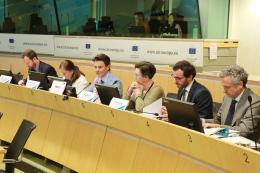
As the global trade landscape grows increasingly complex, European policymakers and business leaders are grappling with the dual challenges of geopolitical instability and shifting transatlantic relations. At a recent panel discussion, Group members discussed with experts the future of EU trade policy, with a particular focus on the transatlantic trade relations ahead of the looming July 9 deadline for resolving EU-US tariff disputes.
The conference "Tackling societal challenges through trusted partnerships" will explore how a collaborative approach can strengthen Europe’s capacity to respond to such challenges. Drawing on the Danish experience, the conference will illustrate how public institutions and social partners work together to develop long-term solutions to complex societal questions. These examples will serve as a basis for dialogue on models of cooperation that could be adapted or expanded across Member States.